Functionality
USER MANUAL FPC 200 - 3/2017 17
Time characteristics
The main purpose of inverse time characteristics (IDMT
– Inverse Definite Minimum Time) is to enable shorter
time of protection trip when the fault current amplitude
is greater. At a set fault value the protection must trip in
time that can be read out from a characteristic. The
operation time depends on the measured current value
in accordance with standards IEC 60255-3 and IEEE C-
37112.
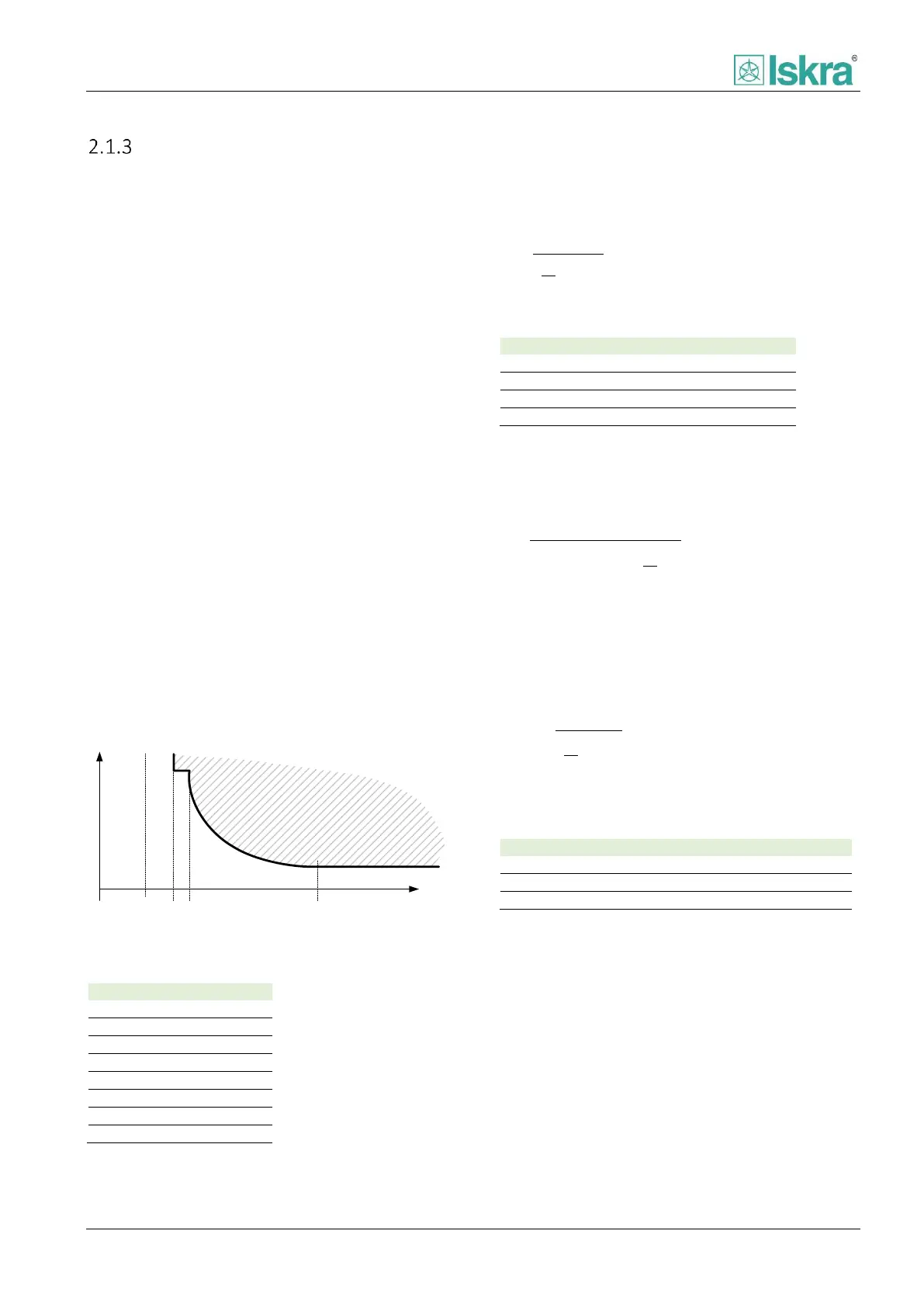
The available area of inverse time characteristic is
defined in a range between 1,1 and 20 I
p
, where I
p
stands for pickup value. Amplitudes above 20 I
p
have an
equal trip delay as the amplitude at 20 I
p
. Amplitudes
from 1,1 I
p
and lower have an equal trip delay as the
amplitude at 1,1 I
p
.
The type of time characteristic can be chosen with the
mode parameter. It is necessary to set the pickup value
and IDMT coefficient parameters. Values are used with
all types of time characteristics. The IDMT coefficient
factor defines the time delay level. Lower values
indicate faster operation at equal fault values.
The fault current amplitude is not always constant and
can change during fault duration. For this reason the
algorithm dynamically integrates parts of time during
the fault according to particular characteristic and when
the sum reaches the switch off limit the protection trips.
0 1,0
drop
out
20 x Pickup
Trip
delay
Fault area
Fault
amplitude
1,1
Figure 2.7: Time inverse characteristic.
Table 3 Time inverse curve types.
2.1.3.1 IEC characteristics
Equation 1 Time to trip for IEC inverse characteristics.
Table 4: Coefficients of IEC characteristics.
2.1.3.2 RI curve
Equation 2 Time to trip for RI inverse characteristics.
2.1.3.3 IEEE characteristics
Equation 3 Time to trip for IEEE inverse characteristics
equation.
Table 5: Coefficients of IEEE characteristics.
set limit of fault range, pickup value



 To Next Page