Functionality
66 USER MANUAL FPC 200 - 3/2017
Trip circuit supervision - ANSI 74 - TCS
Trip circuit supervision function (TCS) is designed for surveillance of breaker control circuits.
2.6.2.1 Functionality
Function is executed autonomously by the device. Two
digital galvanic isolated inputs are used. The result of
Trip circuit supervision function is a signal that can be
used to activate digital output. The signal can also be
accessed using the communication protocol. The
function itself has different operating modes each using
its own connection scheme and alarm status trigger.
Uses CB status for TCS function.
Uses CB status plus one additional digital input.
TCS using external resistor.
TCS without using external resistor.
Table 58: Basic description of TCS module functionalities.
2.6.2.2 Mode 1
Mode 1 is considered basic TCS operation. TCS state is
valid if exactly one of the Input TCS 1 or TCS 2 has value
1. Invalid states are 00 and 11. For each of invalid states
a delay is set. After corresponding delay elapses the TCS
wrong position signal is stated.
After the Delay00 time
elapses.
After the Delay00 time
elapses.
Table 59: TCS function response according to inputs using
Mode 1 setting.
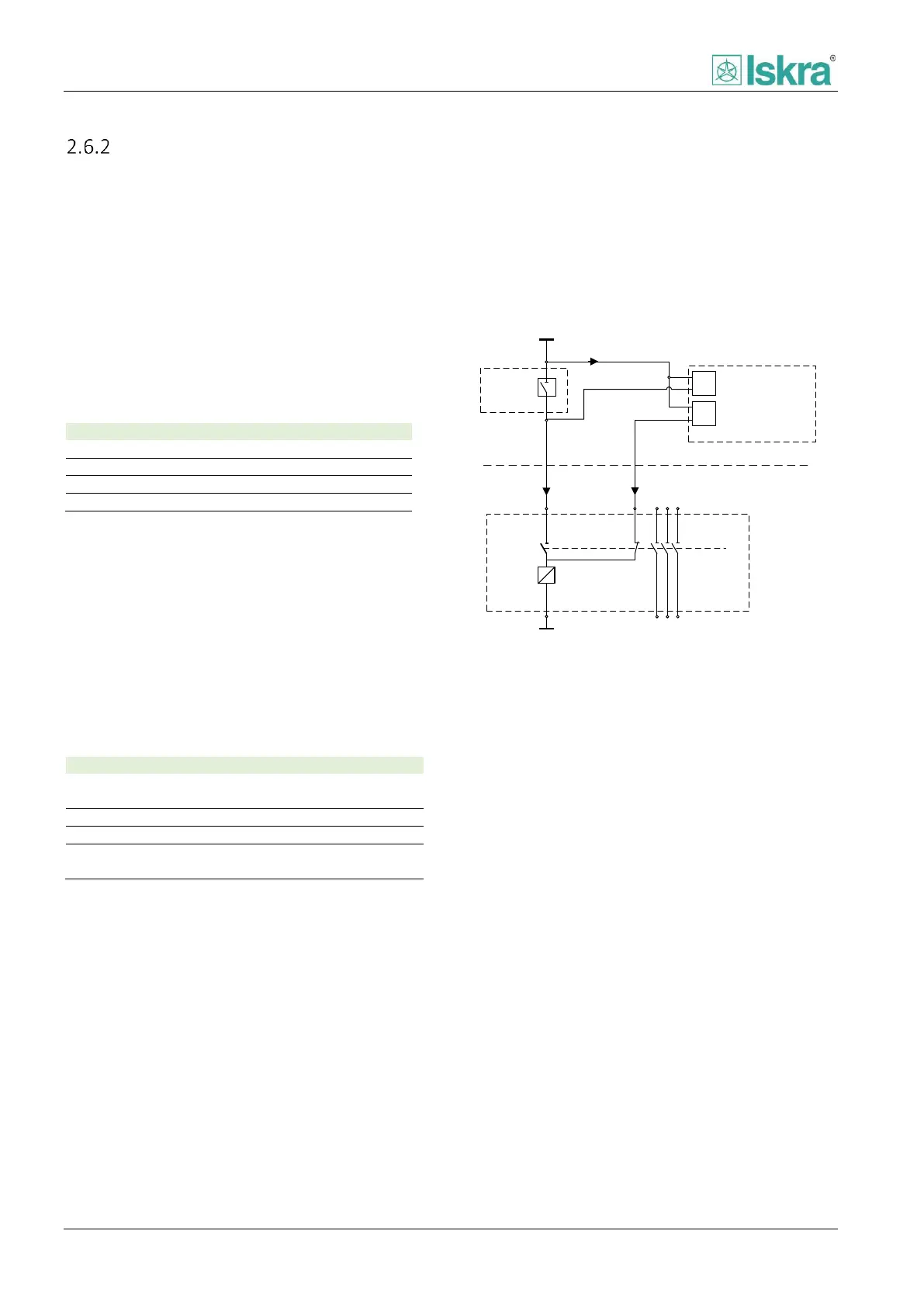
The benefit of using two digital inputs is that only two
digital inputs are used to indicate status of circuit
breaker and monitor the trip circuit. There is also no
need of external resistor to be used. It has to be taken in
to account that, when circuit breaker is in open position
trip circuit supervision does not monitor line from trip
contact to circuit breaker compartment. Scheme can be
found on Figure 2.39
Trip Coil
DI1
DI2
+
+
-
-
ITCS
ITCS2ITCS1
FPC
Circuit
breaker
Trip
contact
CB closed
CB open
Relay compartment
Circuit breaker compartment
L+/L1
L-/N
Figure 2.39 Trip circuit supervision with two digital inputs and
function of monitoring circuit breaker position.



 To Next Page