Slot Card Specifications and Connection Information
E1 card
MAX TNT Hardware Installation Guide A-7
E1 card
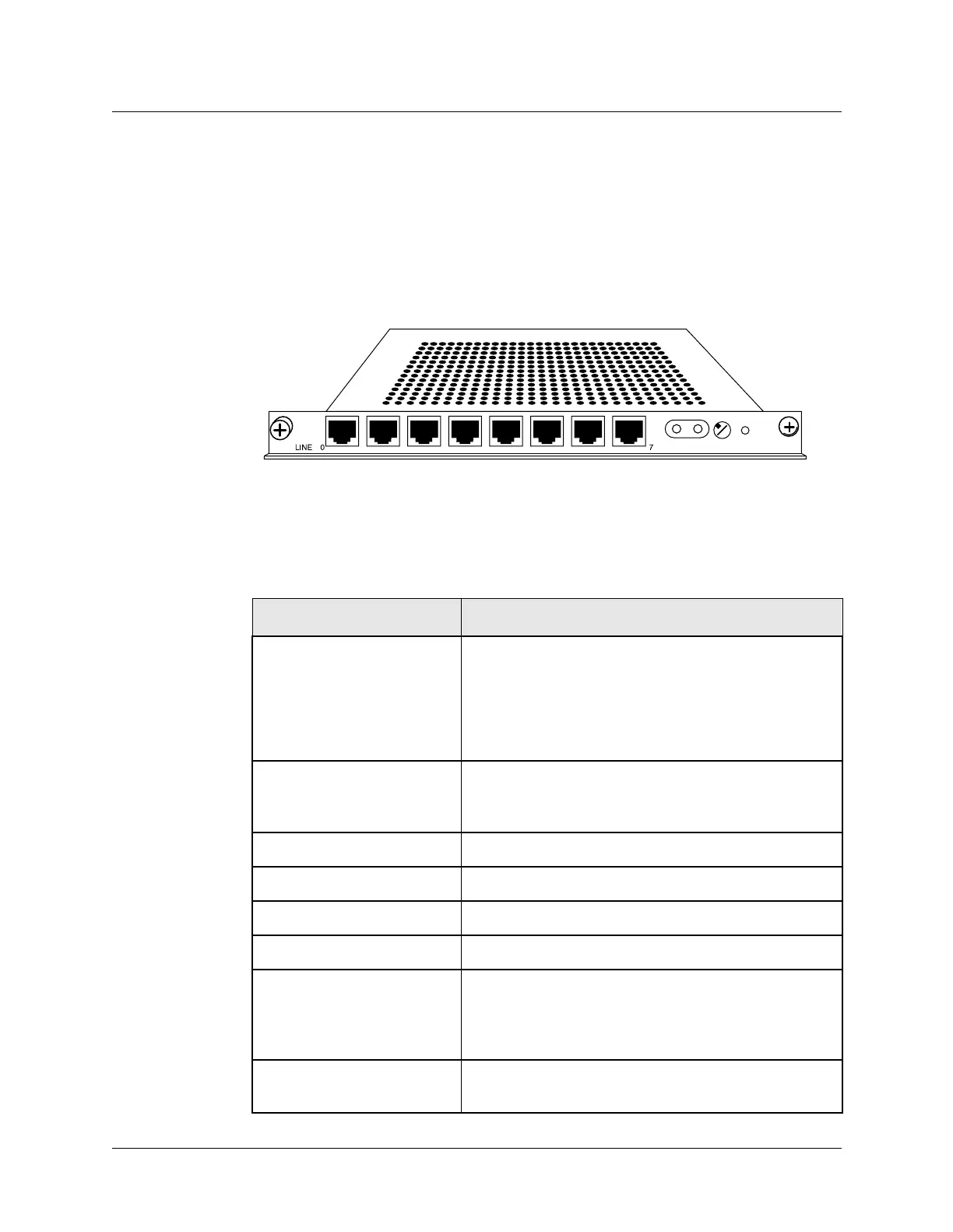
The E1 card provides connections to up to eight E1 lines. An E1 line supports 32 64Kbps
channels, each of which can transmit and receive data or digitized voice. The line uses framing
and signaling to achieve synchronous and reliable transmission. The most common
configurations for E1 lines are ISDN Primary Rate Interface (PRI) and unchannelized.
Figure A-5 shows the E1 card.
Figure A-5. E1 card
Specifications
Table A-4 lists the specifications for the E1 card.
RX TX SEL FAULT
MONITOR
Table A-4. E1 card specifications
Category Specification
Interface standards International Telecommunications Union (ITU) G.703,
G.736, G.775, and G.823
European Telecommunications Standards Institute (ETSI)
300-166 and 300-233
AT&T PUB 62411
Electrical standards Conférence Européenne des Postes et des
Télécommunications (CEPT) 2.048Mbps pulse mask per
G.703 for twisted pair and coaxial cable
Receive equalization Short haul (12dB) and long haul (43dB)
Line code High-density bipolar 3 (HDB3)
Line rate 2.048Mbps +/- 25ppm
Rx sensitivity 0 to -43dB
Frame format Per G.704 frame alignment signal (FAS) with or without
cyclic redundancy check 4 (CRC4) multiframe alignment
(MFA). No channel-associated signaling (CAS) MFA
used for data.
Alarm signaling Red alarm, out of frame (OOF), FAS, alarm indication
signal (AIS), and yellow alarm


 To Next Page