330
Operation
Tires and wheels
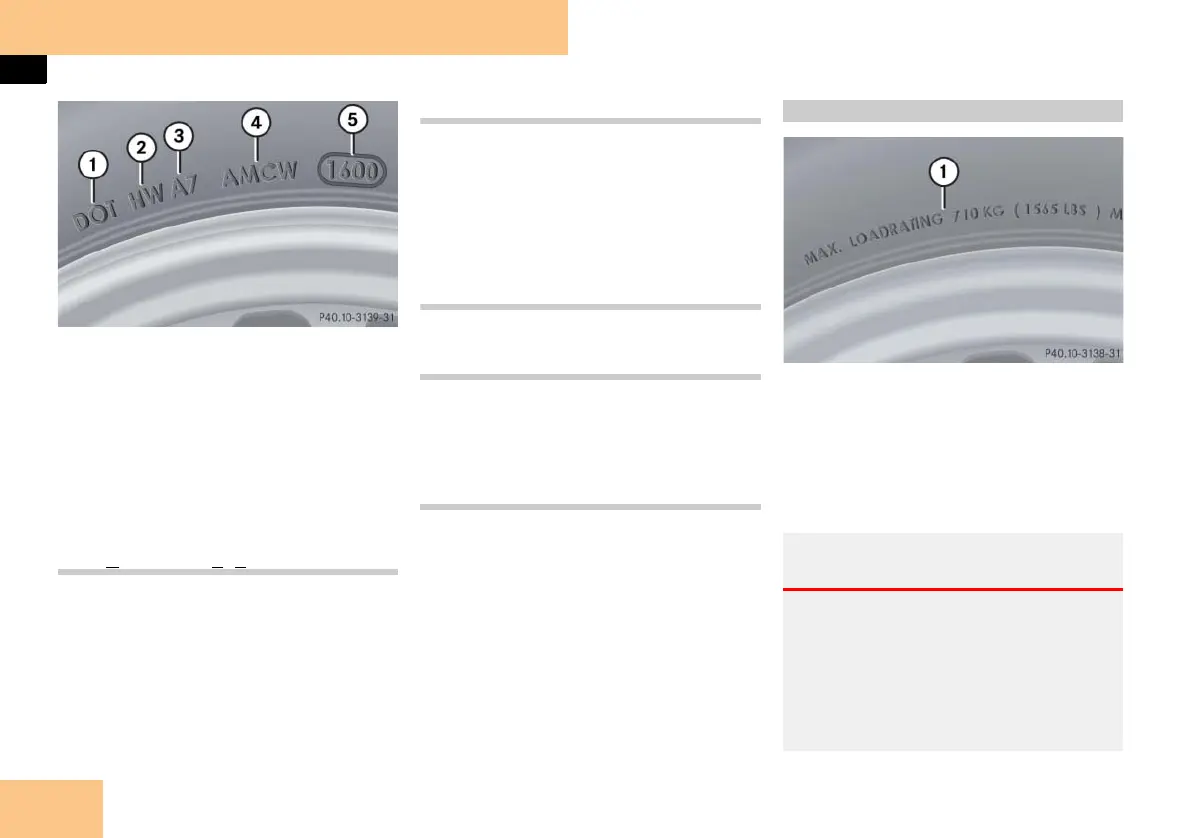
1 DOT
2 Manufacturer’s identification mark
3 Tire size
4 Tire type code (at the option of the
tire manufacturer)
5 Date of manufacture
i For illustration purposes only. Actual data
on tires are specific to each vehicle and may
vary from data shown in above illustration.
DOT (Department of Transportation)
A tire branding symbol 1 which denotes
the tire meets requirements of the
U.S. Department of Transportation.
Manufacturer’s identification mark
The manufacturer’s identification
mark 2 denotes the tire manufacturer.
New tires have a mark with two symbols.
Retreaded tires have a mark with four
symbols. For more information on re-
treaded tires (
컄 page 313).
Tire size
The code 3 indicates the tire size.
Tire type code
The code 4 may, at the option of the
manufacturer, be used as a descriptive
code for identifying significant charac-
teristics of the tire.
Date of manufacture
The date of manufacture 5 identifies
the week and year of manufacture.
The first two figures identify the week,
starting with “01” to represent the first
full week of the calendar year. The sec-
ond two figures represent the year.
For example, “3106” represents the 31st
week of 2006.
1 Maximum tire load rating
i For illustration purposes only. Actual data
on tires are specific to each vehicle and may
vary from data shown in above illustration.
The maximum tire load is the maximum
weight the tires are designed to support.
Maximum tire load
Warning! G
Do not overload the tires by exceeding the
specified load limit as indicated on the
placard located on the driver’s door B-pil-
lar (컄 page 315). Overloading the tires can
overheat them, possibly causing a blow-
out. Overloading the tires can also result in
handling or steering problems, or brake
failure.



 To Next Page