315
Operation
Tires and wheels
Storing tires
! Keep unmounted tires in a cool, dry place
with as little exposure to light as possible. Pro-
tect tires from contact with oil, grease and
gasoline.
Cleaning tires
! Never use a round nozzle to powerwash
tires. The intense jet of water can result in
damage to the tire.
Always replace a damaged tire.
Unidirectional tires offer added advan-
tages, such as better hydroplaning per-
formance. To benefit, however, you
must make sure the tires rotate in the di-
rection specified.
An arrow on the sidewall indicates the
intended direction of rotation (spinning)
of the tire.
i Spare wheels may be mounted against
the direction of rotation (spinning) even with
a unidirectional tire for temporary use only
until the regular drive wheel has been re-
paired or replaced. Always observe and follow
applicable temporary use restrictions and
speed limitations indicated on the spare
wheel.
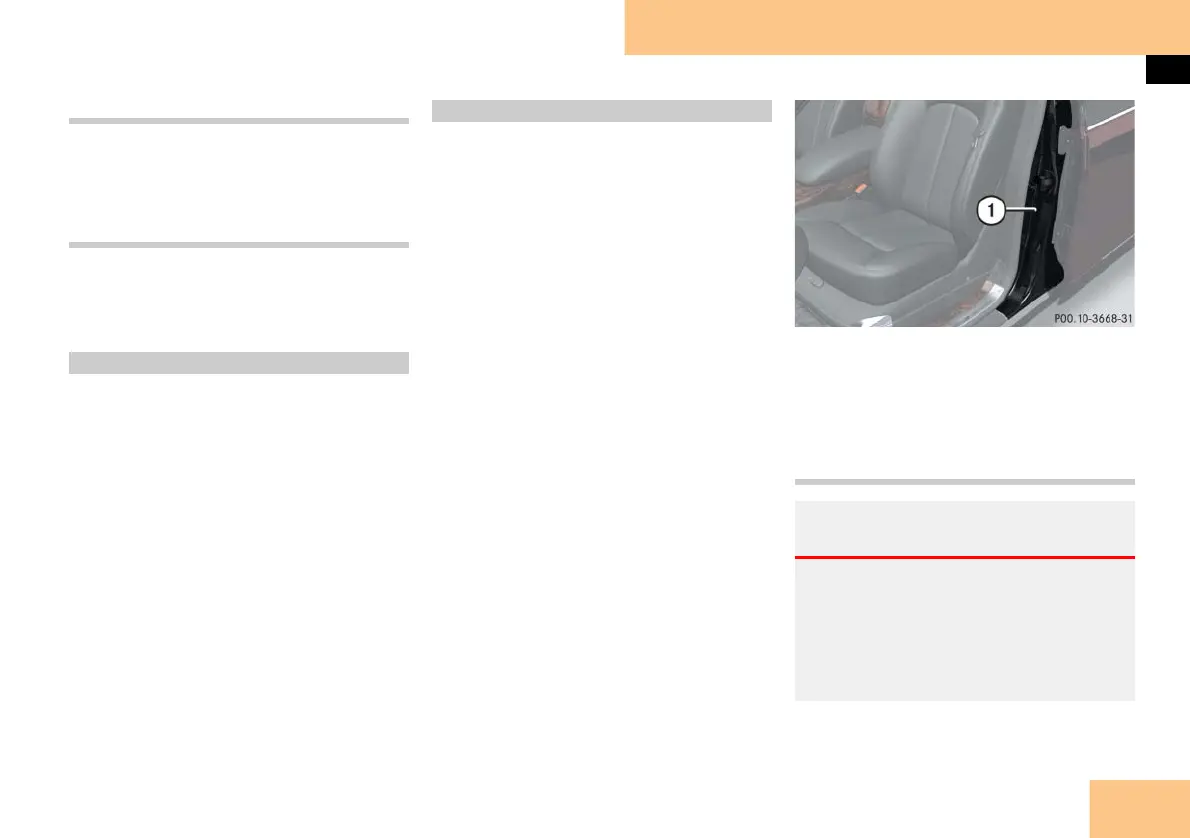
Two labels on your vehicle show how
much weight it may properly carry.
1) The Tire and Loading Information
placard can be found on the driver’s
door B-pillar. This placard tells you
important information about the
number of people that can be in the
vehicle and the total weight that can
be carried in the vehicle. It also con-
tains information on the proper size
and recommended tire inflation pres-
sures for the original equipment tires
on your vehicle.
2) The certification label, also found on
the driver’s door B-pillar tells you
about the gross weight capacity of
your vehicle, called the Gross Vehicle
Weight Rating (GVWR). The GVWR
includes the weight of the vehicle, all
occupants, fuel and cargo. The certifi-
cation label also tells you about the
front and rear axle weight capacity,
called the Gross Axle Weight Rating
(GAWR). The GAWR is the total al-
lowable weight that can be carried by
a single axle (front or rear). Never ex-
ceed the GVWR or GAWR for either
the front axle or rear axle.
1 Driver’s door B-pillar
Following is a discussion on how to work
with the information contained on the
placard with regards to loading your ve-
hicle.
Tire and Loading Information
Direction of rotation
Loading the vehicle
Warning! G
Do not overload the tires by exceeding the
specified load limit as indicated on the
placard on the driver’s door B-pillar. Over-
loading the tires can overheat them, possi-
bly causing a blowout. Overloading the
tires can also result in handling or steering
problems, or brake failure.



 To Next Page