314
Operation
Tires and wheels
Tire inspection
Every time you check your tire inflation
pressure, you should also inspect your
tires for the following:
앫 excessive treadwear (컄 page 314)
앫 cord or fabric showing through the
tire’s rubber
앫 bumps, bulges, cuts, cracks or splits in
the tread or side of the tire
Replace the tire if you find any of the
above conditions.
Make sure you also inspect the spare tire
periodically for condition and inflation.
Spare tires will age and become worn
over time even if never used, and thus
should be inspected and replaced when
necessary.
Life of tire
The service life of a tire is dependent
upon varying factors including but not
limited to:
앫 Driving style
앫 Tire inflation pressure
앫 Distance driven
Tread depth
Do not allow your tires to wear down too
far. Adhesion properties on wet roads
are sharply reduced at tread depths of
less than
1
/
8
in (3 mm).
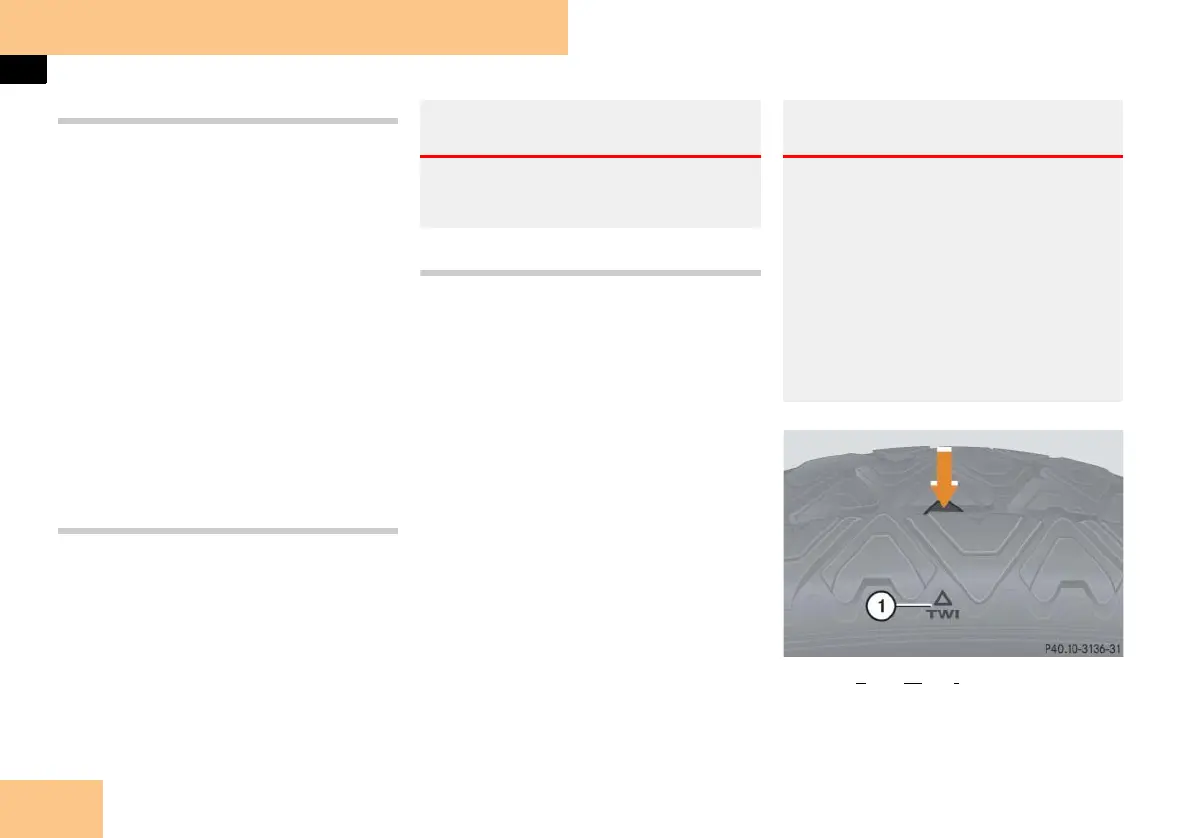
Treadwear indicators (TWI) are required
by law. These indicators are located in six
places on the tread circumference and
become visible at a tread depth of ap-
proximately
1
/
16
in (1.6 mm), at which
point the tire is considered worn and
should be replaced.
Recommended minimum tire tread
depth:
앫 Summer tires
1
/
8
in (3 mm)
앫 Winter tires
1
/
6
in (4 mm)
1 TWI (T
readWear Indicator)
The treadwear indicator appears as a sol-
id band across the tread.
Warning! G
Tires and spare tire should be replaced af-
ter 6 years, regardless of the remaining
tread.
Warning! G
Although the applicable federal motor
safety laws consider a tire to be worn
when the treadwear indicators (TWI) be-
come visible at approximately
1
/
16
in
(1.6 mm), we recommend that you do not
allow your tires to wear down to that level.
As tread depth approaches
1
/
8
in (3 mm),
the adhesion properties on a wet road are
sharply reduced.
Depending upon the weather and/or road
surface (conditions), the tire traction varies
widely.



 To Next Page