63
Getting started
Adjusting
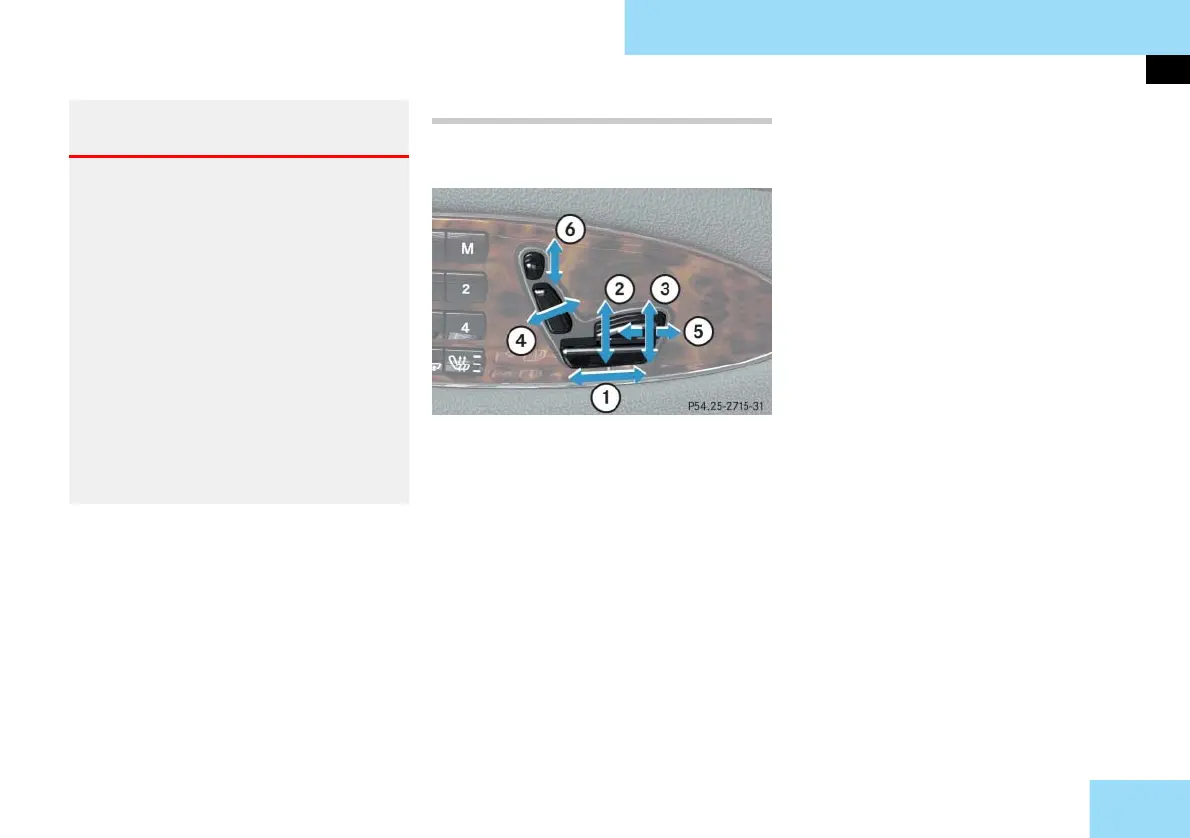
Seat adjustment
The seat adjustment switches are located
on each door.
1 Seat fore and aft adjustment
2 Seat height
3 Seat cushion tilt
4 Seat backrest tilt
5 Seat cushion depth
6 Head restraint height
왘 Switch on the ignition (컄 page 60).
or
왘 Open the respective door.
i The memory function (컄 page 140) lets
you store settings for the seat positions to-
gether with the settings for the steering
wheel and rear view mirrors.
! When moving the seat, make sure there
are no items in the footwell or behind the
seats. Otherwise you could damage the seats.
Seat fore and aft adjustment
왘 Press switch forward or backward in
direction of arrow 1.
i Depending on the set height of the head
restraint, the seat fore and aft position is au-
tomatically pre-set.
Seat height
왘 Press switch up or down in direction
of arrow 2.
Seat cushion tilt
왘 Press switch up or down in direction
of arrow 3 until your upper legs are
lightly supported.
Seat backrest tilt
왘 Press switch forward or backward in
direction of arrow 4.
Warning! G
According to accident statistics, children
are safer when properly restrained in the
rear seating positions than in the front
seating position. Thus, we strongly recom-
mend that children be placed in the rear
seats whenever possible. Regardless of
seating position, children 12 years old and
under must be seated and properly se-
cured in an appropriate infant or toddler
restraint, or booster seat recommended
for the size and weight of the child. For ad-
ditional information, see “Children in the
vehicle” (컄 page 95).
A child’s risk of serious or fatal injuries is
significantly increased if the child re-
straints are not properly secured in the ve-
hicle and the child is not properly secured
in the child restraint.
컄컄



 To Next Page