MM182-001 – Operator Manual
112
4. MAINTENANCE, CLEANING AND DECONTAMINATION
The procedure described in this chapter must be performed on a daily basis or according
to laboratory regulations.
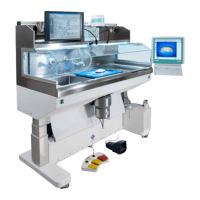
The personnel involved in the cleaning and decontamination of UltraGROSS and its
optional parts (if any) must wear suitable personal protective equipment (gloves, goggles,
facemask) according to standards in force.
Decontamination of the unit is mandatory due to the biohazard arising from the use of fresh
or semi-fixated specimens.
Make sure the contaminated material is packed and disposed of in an approved incinerator
in compliance with all federal, provincial and local government regulations.
4.1. UltraGROSS cleaning precautions
Cleaning must be performed on a daily basis or according to laboratory regulations.
The anti-corrosion properties of steel decrease under the effect of acids and halogenated compounds
(chlorine, bromide, iodide).
When working on a stainless steel surface or during cleaning procedures:
- Never use chlorine-based solutions at any concentration and temperature,
- Never use corrosive substances at any concentration or temperature (acids in general),
- Do not use the following fixatives: B5, AFA, zinc chloride formalin, mercury based formalin,
- Do not clean the surface with abrasive objects,
- Do not leave containers with a temperature higher than 100°C (212°F) on the surface.
Avoid rust deposits caused by foreign objects, like particles of rust from other objects and not coming directly
from the stainless steel product. For example, tweezers, paper clips, scissors, scalpels, or inadequate cleaning
tools.
Do not soak or rinse the PC, its peripheral devices or the camera.
Do not use abrasive cloths to clean the camera lenses
If there is an accidental leakage of liquid from the auxiliary sockets, contact your clinical
engineering service in relation to the safety of the unit before operating it again.
Do not place in autoclave or clean the PC or its peripheral devices or the camera with
strong aromatic, chlorinated, ketone, ether or ether solvents (like ethyl acetate or methyl
palmitate), sharp tools or abrasives.
Never immerse electrical connectors in water or other liquids.
Despite the columns being protected against direct sprays or water jets (IPX6),
nonetheless avoid this type of operation.
Do not clean the areas surrounding the unit (walls, windows, flooring) with solutions
indicated in the list above.
Clean all the filters on a daily basis, removing any pieces that may obstruct the passage.
Use running water and, if necessary, also a brush with nylon bristles.


 To Next Page