.-_-_-. (.
. .
.
.
.
.
..-
.:
-..
t:---
--.
5.04
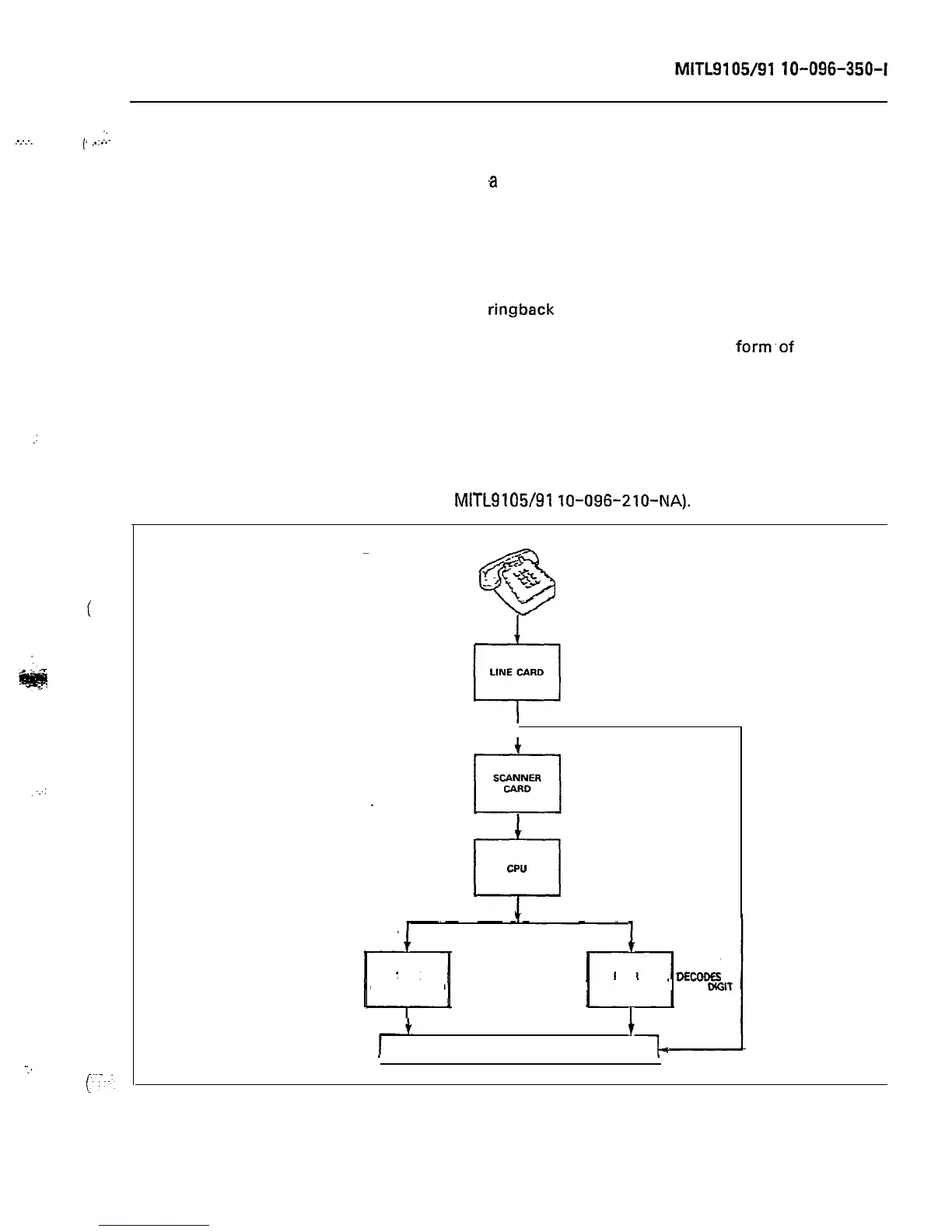
If the call is an inside call (within the PBX), the extension must
access a speech path as per paragraph 5.01. The receiver will
decode the first digit dialed. The Scanner card will inform the CPU that
decoded digit for it. The CPU will consult the RAM
as per paragraph 5.02 to determine the validity of the digit and the
action required. Until the CPU is able to confirm an action to be
performed with the digits received, all digits will be stored in the RAM.
Should the first digit or digit sequence be considered invalid by the
CPU, reorder tone (from the Tone Control card) is connected to
speech path. A valid extension number causes the Tone Control card
to provide either
ringback
or busy tone (all tones are controlled by the
CPU) to the calling extension. Before actually ringing the called exten-
sion, the CPU consults its RAM to check for any
form.of
ing, Do Not Disturb or extension restriction (i.e., Originate Only). In
these cases, the calling extension will be forwarded or it will receive
reorder tone (from the Tone Control card).
5.05
If the call is an outside call with no dialing restriction, the
extension must be assigned a speech path (paragraph 5.02). The
CPU will locate a free trunk corresponding to the access code dialed
(see Section
MITL9105/91
lo-096-270-NA).
If there is not a free trunk,
SUPPLIES
DIAL TONE,
BUSY TONE,
REORDER TONE
ONE OF EIGHT
EQUIPMENT NUMBERS
DETECTS
OFF-HOOK
1 1
TONE
RCVR
DECODES
CONTROL CARD
CARD
*
FIRST
OK3T
c
+
SPEECH PATHSPEECH PATH
Figure 5-2 Select a Speech Path






 To Next Page