SECTION
MITL9105/91
lo-096-350-NA
then connects a receiver and a dial-tone generator. This allows the
._’
”
c+
trunk to appear as though it were an extension. A
DISA
trunk enables a
dial-in caller to dial internal stations and features.
5.16 Figure 5-6 identifies all equipment numbers that may be as-
signed in an SX-lOO/SX-200 system. This figure will aid the
repair person in the association of equipment numbers to specific
slots and thereby specific cards. There are eight extensions per Line
card slot, two E/M or tie trunks per trunk card slot or four CO trunks
per Trunk card. All trunk equipment numbers will appear as even
numbers (i.e., 50). For the explanation of the error codes and their
meaning see Part 4 of this Practice.
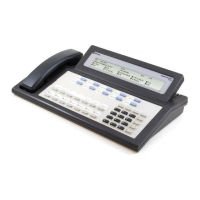
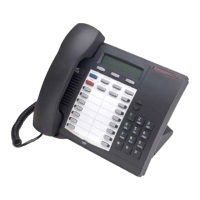
SUPERSET
4 Set Operation
.
.
,
:
.
.
.
.
-.:
.:
:.
(:...
5.17 Each
SUPERSET
set is assigned to a specific equipment number
on a specific
SUPERSET
Line card. When a
SUPERSET
set goes
off-hook, the UART on the Line card informs the CPU, and the CPU
causes the LED (on the Line card) associated with that equipment
number to light. At this time there are up to 31 speech paths available
for assignment to the off-hook
SUPERSET
set. Each Line card has an 8
x 32 switching matrix, providing access to 31 speech paths and one
Music-on-Hold (MOH) path. The CPU (through its Random Access
Memory (RAM)) will find a free speech path and test it, using circuits
on the Tone Control card. After the speech path is tested, the CPU
connects it to the line circuit. Dial tone
from,the
Tone Control card is
then connected to the free speech path.
5.18 When the first digit is dialed, the CPU determines if the digit is
a requirement for an internal call or external call, or if more
digits are required to define the call. Regardless, upon reception of the
first digit, the CPU will inform the Tone Control card to drop the dial
tone. If the option selected (as defined by the digits dialed) is busy, the
SUPERSET
set will receive busy tone from the Tone Control card. The
CPU will react to the first digit or the remaining digits as per the
following paragraphs.
5.19 When a
SUPERSET
set dials a sequence that requires the use of
a feature, the CPU must first check the
SUPERSET
set’s COS. If
the
SUPERSET
set’s COS does not allow access to that feature, it will
be assigned (by the CPU) reorder tone from the Tone Control card. If
feature access is permitted, the CPU will act according to the memory
stored in the RAM. All information will be stored in the system’s RAM
by the CPU. It should be noted that the Scanner card informs the CPU
that the Receiver card has a digit decoded for each digit on a trunk the
SUPERSET
set dials. The CPU controls all tones (Le., supervisory tones
that the
SUPERSET
set may receive), switching them on/off at the
correct rates.
5.20 If the call is an inside call (within the PBX), the
SUPERSET
set
must access a speech path as per paragraph 5.17. The CPU will
decode the first digit dialed. The CPU will consult the RAM as per
paragraph 5.18 to determine the validity of the digit and the action
required. Until the CPU is able to confirm an action to be performed
Page 61






 To Next Page