_.
-
._
i,~
/
SECTION
MITL9105/91
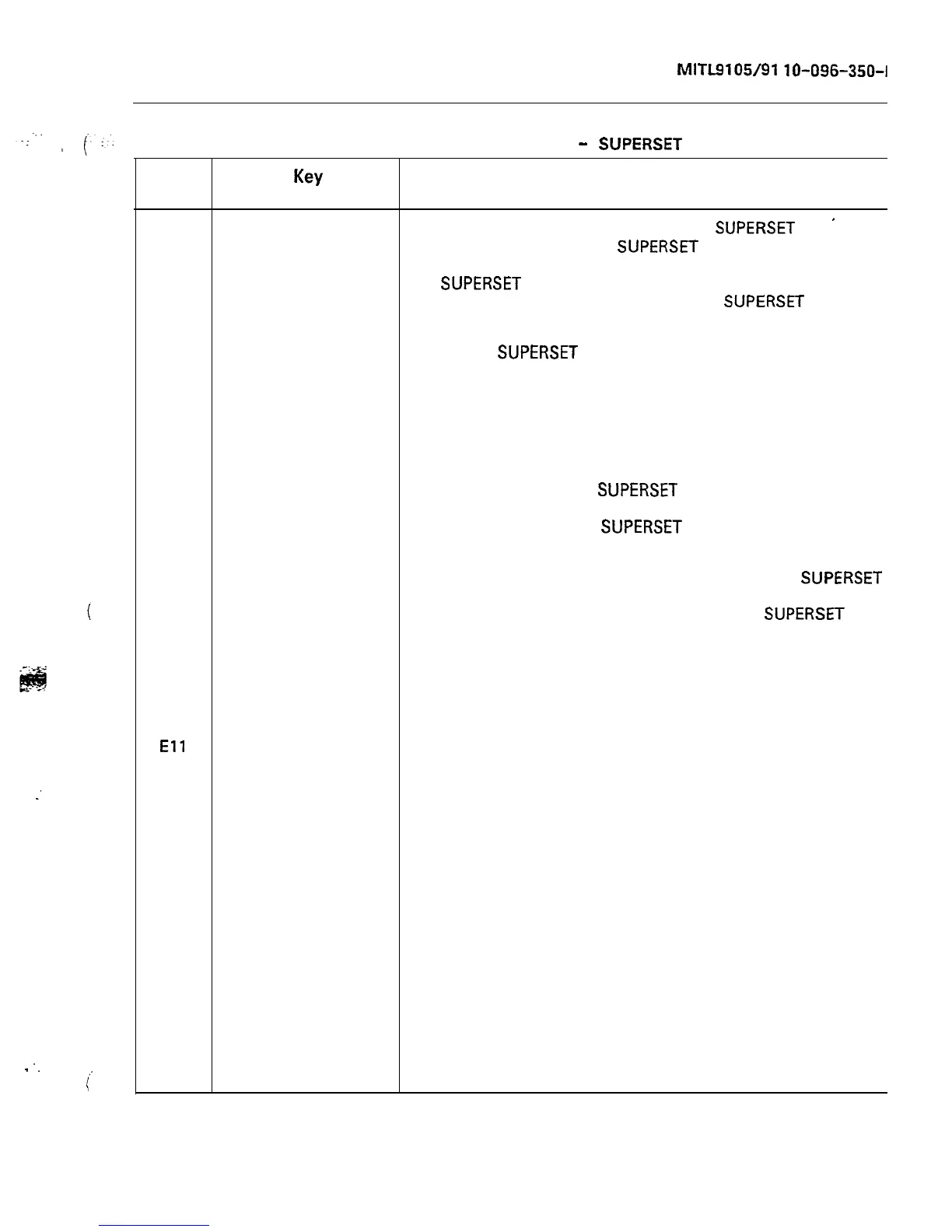
TABLE 4-12
EXTENDED PROGRAMMING ERROR CODES
-
SUPERSET
PROGRAMMING
Error
Code
EO
Key
Involved Explanation
This error is given when entering the
SUPERSET
set
I
programming if either the
SUPERSET
the Supervisor attempts to use Customer Programming of
the
SUPERSET
set and System Option 272 is not enabled.
This error is also given throughout the
SUPERSET
4 set
programming when an invalid key is pressed.
El PRIME KEY Entering a
SUPERSET
set equipment number as slot 1
(equipment numbers 001-008).
El PRIME KEY
Number out-of-range error. Given in PRIME KEY mode when
attempting to enter COS number, Toll Deny, Busy Lamp
number, Pickup Group number, or Call Announce Port
number.
E3
SET EQPT NUMBER
Given when entering a
SUPERSET
set equipment number if
the number supplied is defined within the system is
something other than a
SUPERSET
4 set Also given if the
key type supplied is not valid.
E3
PRIME KEY Attempting to assign an equipment number as a
SUPERSET
set when other equipment numbers previously programmed
for that slot identify the slot as other than a
SUPERSET
Line
card.
E4
El0
El1
El2
El3
E20
E21
SET KEY NUMBER
LISTED NUMBER
TYPE
LISTED NUMBER
TRUNK EQPT
NUMBER
LISTED NUMBER
LISTED NUMBER
Given if the key number supplies is invalid (other than 2-15).
Directory number was not entered when attempting to define
a Prime key.
Type was not entered when attempting to define a
Non-Prime key.
Directory number was not entered before defining a
Non-Prime key.
Trunk equipment number was not entered when required
when defining a Non-Prime key.
The directory number supplied is conflicting with an existing
system access code. This error is also given when
attempting to add a key line appearance of a single line set.
The appearance of a single line set must be multiple call.
The directory supplied is invalid, because it would result in
mixing key line and multiple call appearances with the same
directory number. This error occurs when attempting to add
a Non-Prime key, and the directory number exists as either a
prime with the wrong type of appearances or a primeless list
of the wrong type (i.e., key line or multiple call).






 To Next Page