SECTION
MITL9105/91
lo-096-350-NA
output. At this time, digits being sent by the Trunk card are monitored
f
by the receiver and are subject to Multi-Digit Toll Control (if enabled).
The CPU will consult the RAM memory as to toll control for each digit
received. If the call is allowed by toll control, the call will go through. If
the call is not allowed, reorder tone will be returned from the Tone
Control card and the trunk will be released.
5.08 The circuit operations described above are similar to those
required for Tie-Trunk circuits with the following exception. For
DP extensions to DP tie-trunk circuits, the requirement exists to inhibit
dial-train distortion arising as a result of tandem operation through
one or more tie trunks. For this reason, when the trunk processor
receives the input data it causes the output to the tie-trunk to be a
regenerated train of dial pulses. The trunk processor will isolate the
speech path to prevent dial pulses from feeding back to the extension.
Console
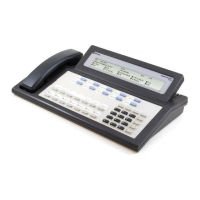
5.09 The console does not have a switchhook, rather the console is
off-hook whenever the console handset is plugged in. To origi-
nate a call it is only necessary to press the button of the figure
number or feature. The console communicates through the Intercon-
nect card to the system via the- Console Control card. The Scanner
card will then inform the CPU that the Console Control card has
information for it. Note: A Receiver card is not used for dialing from
the console. As in the case of an extension the console must be
assigned a free speech path. This is done after the first button (l-9, 8,
++
or feature button) is pressed. If an invalid digit or digit sequence is
entered, the console will receive reorder tone from the Tone Control
card. If all speech paths are occupied, the console will receive no
tones or audio from the system. The Tone Control card will also
provide ringback or busy tone for the console.
5.10
The dialing of a valid extension number prompts the CPU to
select a particular extension on a particular Line card (as deter-
mined by the programming in the non-volatile RAM). The CPU sends a
command to turn ringing current on and off to the extension. When the
extension is answered, the CPU detects an off-hook and disconnects
ringing. The CPU then connects the called extension to the speech
path of the console.
Dialing a Trunk (From a Console)
5.11 The console dial pad produces digital signals which are stored
by the CPU. After the trunk access code has been dialed, the
subsequently keyed signals are forwarded to the CPU, where, after
decoding, they are forwarded to the Trunk card and outpulsed to the
trunk line. Note that a Receiver card is not required for this configura-
tion. If the circuit is programmed as a DTMF trunk circuit, a tone
generator will be inserted. This results in the signals being translated
into DTMF tone pulses which are then placed on the speech path (not
into the Trunk card) and forwarded to the trunk circuit for outward
transmission. The audio path is isolated back to the console when the
DTMF transmission takes place.
Page 58






 To Next Page