ELECTRICAL 2. INSTALLATION
2-14
REDUCED RTD LEAD NUMBER APPLICATION:
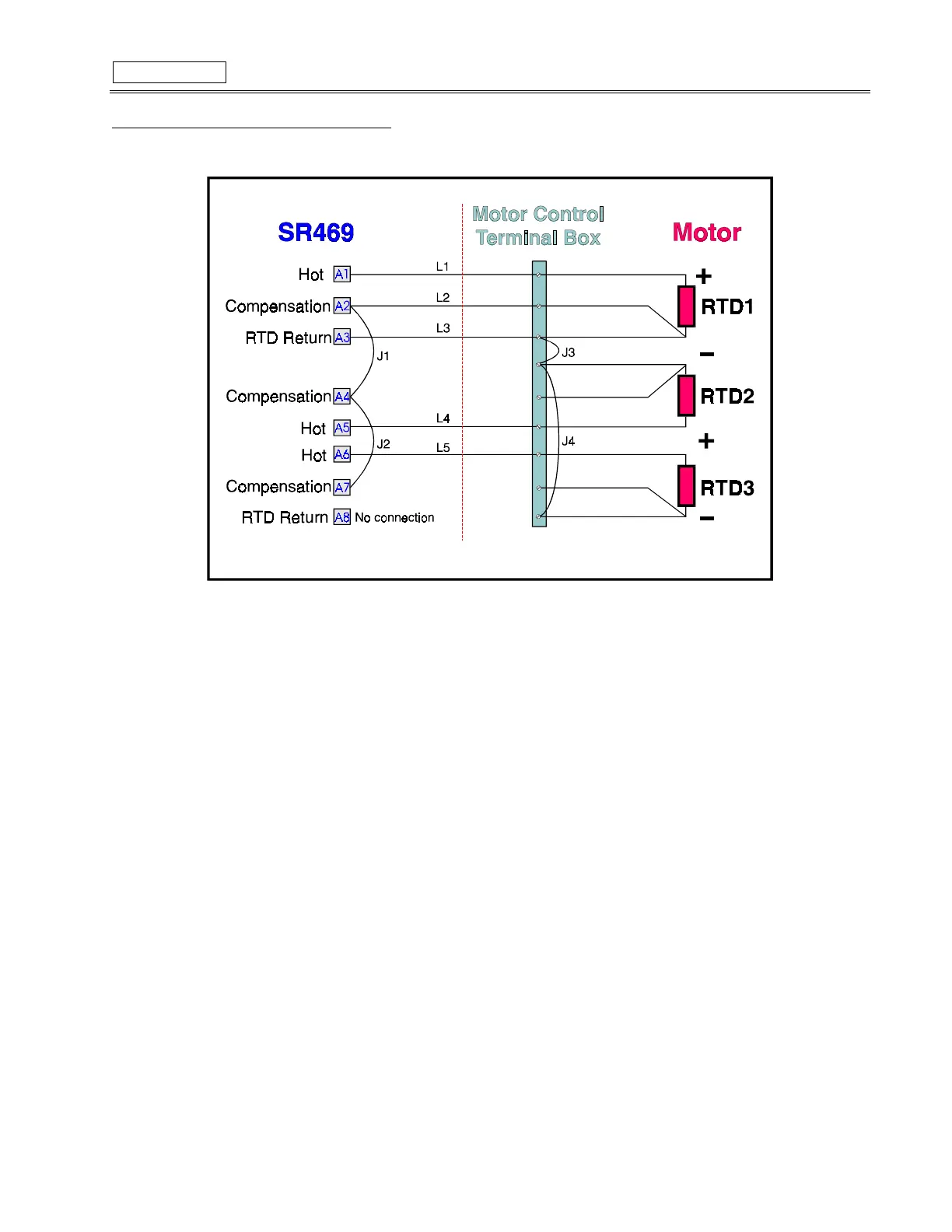
The SR469 requires three leads to be brought back from each RTD: Hot, Return and
Compensation. This can be quite expensive. It is however possible to reduce the number of leads required to 3 for the first RTD and 1
for each successive RTD. Refer to Figure 2-22 for wiring configuration for this application.
Figure 2-22 REDUCED WIRING RTDs
The Hot line for each RTD would have to be run as usual for each RTD. The Compensation and Return leads however, need only be
run for the first RTD. At the motor RTD terminal box the RTD Return leads must be jumpered together with as short as possible jump-
ers. At the SR469 relay the Compensation leads must be jumpered together.
It can be noted that there is an error produced on each RTD equal to the voltage drop across the jumper on the RTD return. This error
would increase on each successive RTD added.
V
RTD1
= V
RTD1
V
RTD2
= V
RTD2
+ V
J3
V
RTD3
= V
RTD3
+ V
J3
+ V
J4
V
RTD4
= V
RTD4
+ V
J3
+ V
J4
+ V
J5
etc...
This error is directly dependent on the length and gauge of the wire used for the jumpers and any error introduced by a poor connection.
For RTD types other than 10C the error introduced by the jumpers is negligible.
This RTD wiring technique reduces the cost of wiring, however, the following disadvantages must be noted:
1. Error in temperature readings due to lead and connection resistances.
Not
recommended for 10C RTDs.
2. If the RTD Return lead to the SR469 or one of the jumpers breaks all RTDs from the point of the break on will read open.
3. If the Compensation lead breaks or one of the jumpers breaks all RTDs from the point of the break on will function without any lead
compensation.


 To Next Page