SHAPING THE FUTURE OF SATELLITE COMMUNICATIONS
8.1.2 DVB-DSNG
The DVB-DSNG standard is an extension to the DVB-S standard introduced for
professional applications such as Digital Satellite News Gathering or television
contribution services. DVB-DSNG introduces higher order modulation schemes
(8PSK and 16QAM) and additional signal roll-off factors.
The transported signals are the same as for DVB-S.
8.1.3 DVB-S2
DVB-S2 is the second generation of the DVB standard for broadcast of satellite. It
introduces new correction codes (BCH and LDPC) that are typically 30% more
efficient then the codes used in DVB-S. The DVB-S2 standard also introduces a
range of new features such as:
• Higher order modulation schemes 16 APSK and 32 APSK;
• Sharper roll-off factors;
• A new framing structure called “Baseband frames”;
• The ability to vary the modulation parameters dynamically. This is used in
modes called “Variable Coding and Modulation” and “Adaptive Coding and
Modulation”;
• The ability to carry several signals on a single satellite carrier, without
multiplexing in front of the modulator. This is called “multi-stream””;
• The ability to carry signals other than MPEG transport stream. This is called
“Generic Stream”.
These features are further explained in the following sections:
8.1.3.1 DVB-S2 Framing Structure
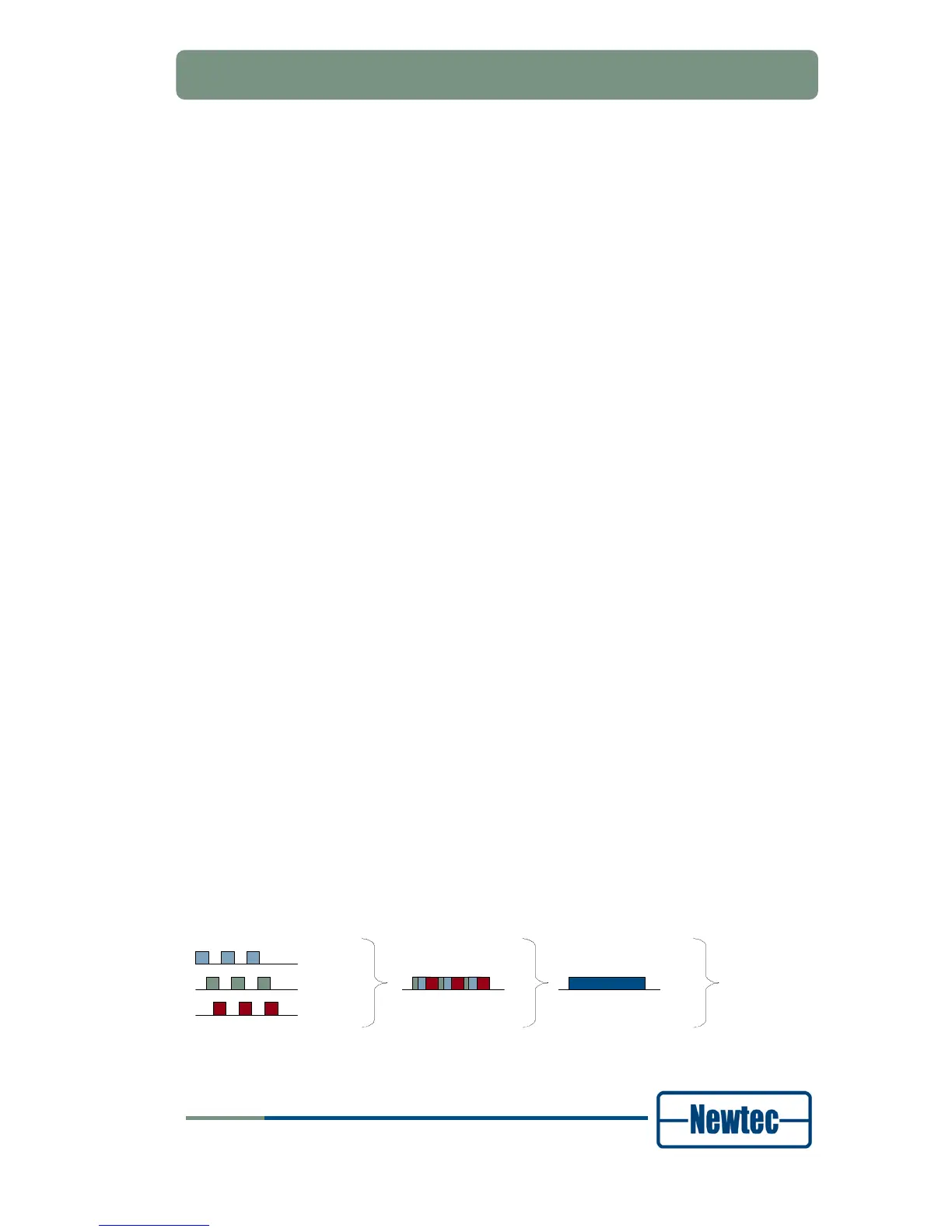
DVB-S2 applies the error correction coding and the modulation to large frames of
data called Baseband frames. A DVB-S2 baseband frame is either 16200 bits
(short frames) or 64800 bits (normal frames). The content of a frame can be a
section of a transport stream, or any type of data, framed or unframed (Generic
Stream). Note that the DVB-S2 standard specifies how to encapsulate transport
streams into Baseband frames, but not how to encapsulate IP data into Baseband
frames.
Newtec has developed a proprietary encapsulation format called XPE (Extended
Performance Encapsulation), which is much more efficient than MPE.
Figure 59- Transport Stream Carried over DVB-S2


 To Next Page