SHAPING THE FUTURE OF SATELLITE COMMUNICATIONS
9.6.3 Data Flows
Real-time traffic and non-real-time traffic are stored in a separate queue as
described in previous paragraph. In such a situation, it is still possible that one end-
user fills one of these queues completely. This is especially noticed for the large
non-real-time queue: if one end user manages to fill this queue, it may take a long
time (e.g. 819 ms for our low speed satellite link example of 1Mbps) before other
end users can transmit their data.
The problem can only be solved, by the device that knows how narrow the
bottleneck is.
A shaper can be put in front of the satellite modulator. The shaper is than
configured in such a way, that it forwards the data at exactly the same bit rate as
the modulator can transmit. In this case, the shaper can guarantee fairness
amongst all end users.
With the recent evolution of dynamic satellite bandwidths (VCM or ACM), it
becomes difficult for a shaper to guarantee fairness amongst end users. There are
not so many shapers that shape traffic for a dynamically changing satellite
bandwidth.
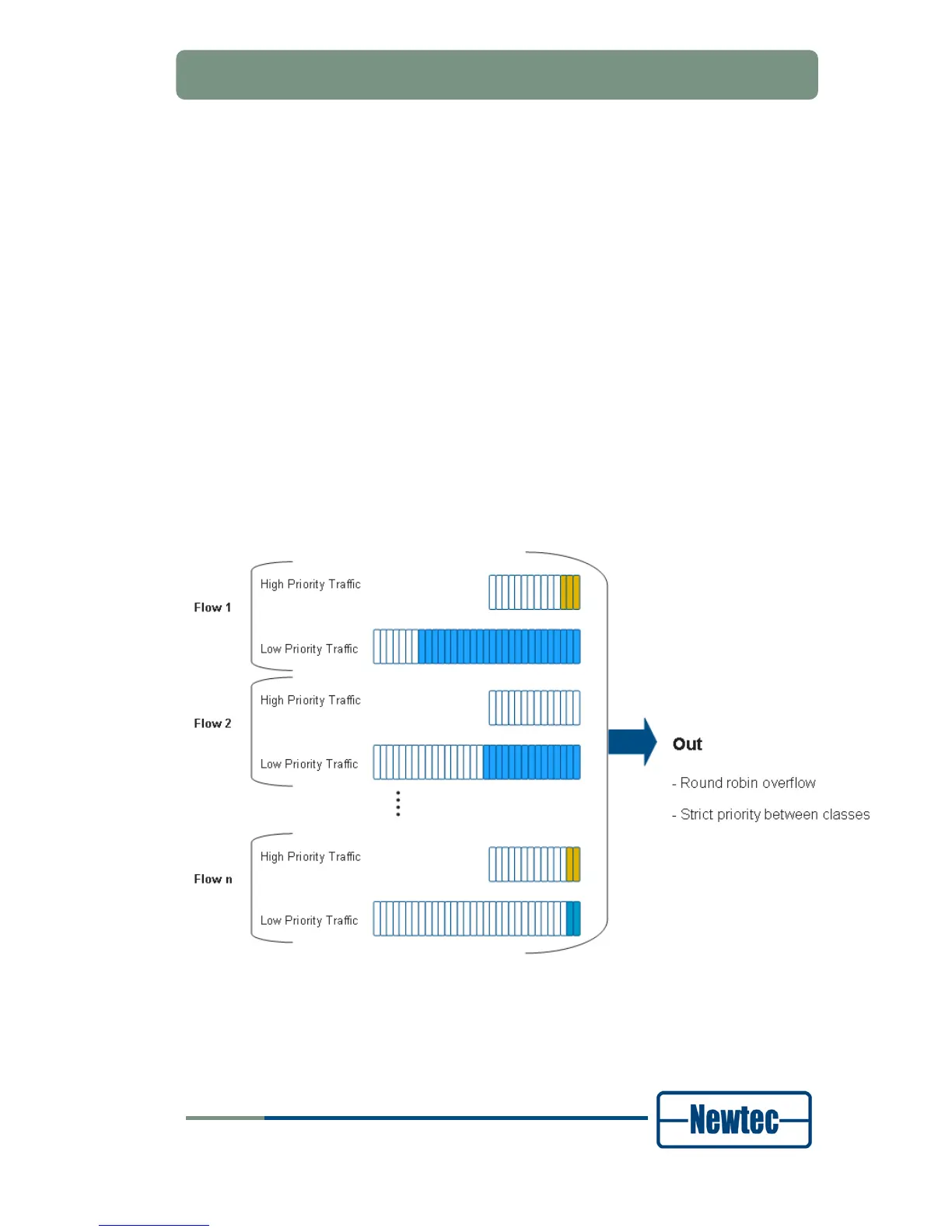
The second, preferred strategy is to perform the shaping in the modulator and is
visualized in the next figure.
Figure 96 – Example of Quality of Service Implementation


 To Next Page