SHAPING THE FUTURE OF SATELLITE COMMUNICATIONS
Optimal ModCod Based on EsNo
The demodulator detects the received EsNo of the signal. Based on this value it
selects the optimal ModCod. This mode is used when there is no distortion, for
example in a multicarrier transponder with sufficient output back off.
The ACM client application compares this measured value with the sum of:
• Threshold: Each ModCod has its own EsNo threshold. This is the required
EsNo value, needed to decode the frames correctly. This value is characteristic
for the demodulator and can be found in the datasheet of the device;
• Distortion Margin: For each ModCod, there may be a different level of distortion
added to the received signal. This type of distortion is caused by non-linearity in
the transmission chain, e.g. a saturated transponder;
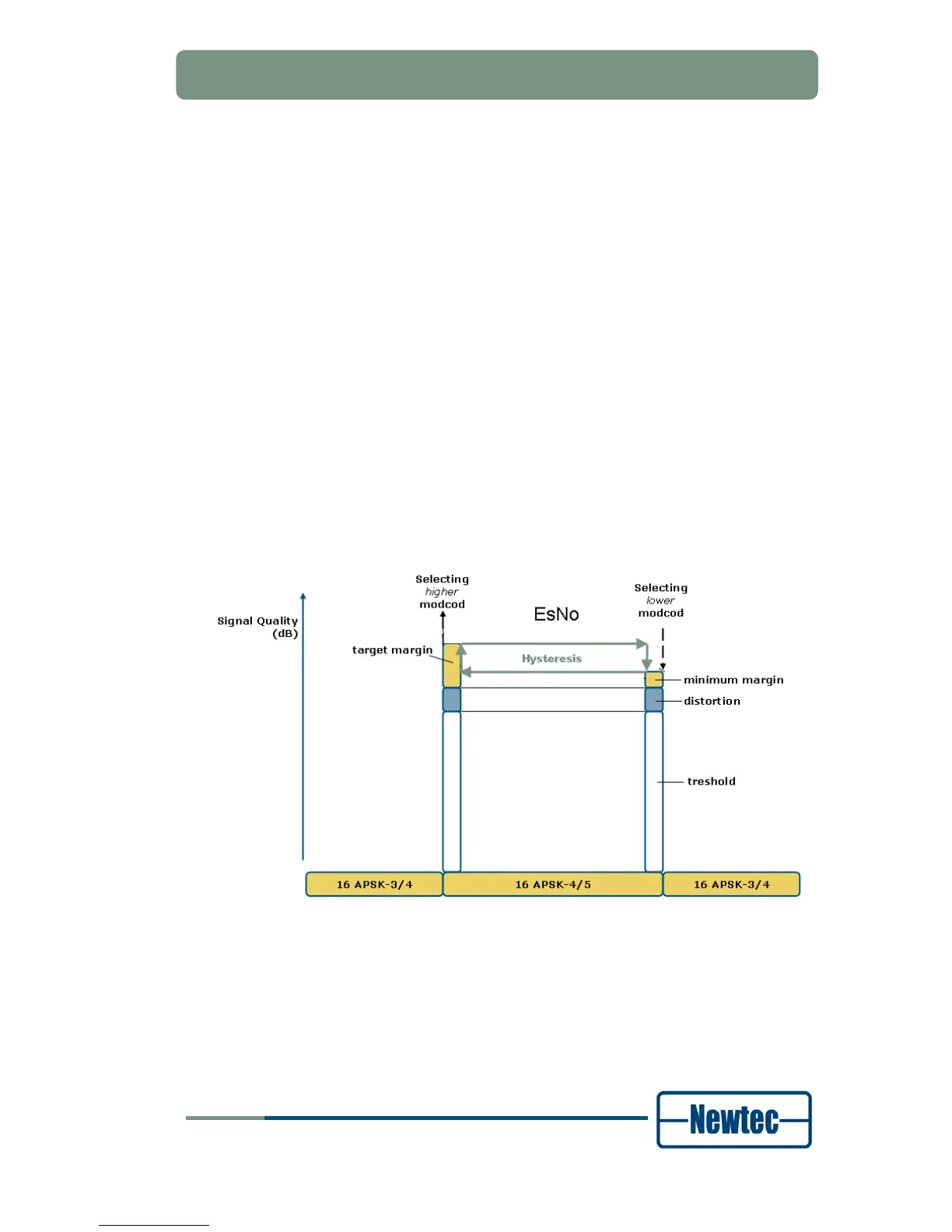
• Hysteresis: When the signal quality improves and the following limit is reached:
Threshold + Target margin (step up margin)
a higher ModCod is selected.
When the signal quality decreases and goes under the following limit:
Threshold + Minimum margin (step down margin)
a lower ModCod is selected.
The Minimum margin is set smaller then the Target margin to create a
hysteresis of Target margin – min margin in dB. This prevents toggling of
ModCods at a certain value.
This is shown in Figure 76
Figure 76 - Hysteresis
A higher ModCod is selected when the measured EsNo is higher than the sum of
the threshold of the higher ModCod, the configured distortion for this higher
ModCod, and the target margin for this higher ModCod.


 To Next Page