Outline
1.2 Component Names and Functions
1-5
1.2 Component Names and Functions
No. Name Function
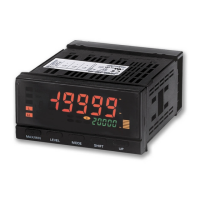
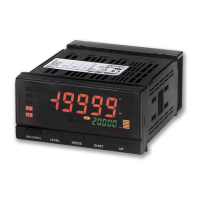
PV display Displays PVs, maximum values, minimum values, parameter names, and
error names.
SV display Displays SVs and monitor values.
Position meter Displays the position of the PV with respect to a desired scale.
Comparative output
status indicators
Display the status of comparative outputs.
Max/Min status
indicator
Turns ON when the maximum value or minimum value is displayed in the
RUN level.
Level/bank display In RUN level, displays the bank if the bank function is ON. (Turns OFF if the
bank function is OFF.)
In other levels, displays the current level.
Status indicators T-ZR: Turns ON when the tare zero function is executed. Turns OFF if it is
not executed or is cleared.
Zero: Turns ON when the forced-zero function is executed. Turns OFF if it
is not executed or is cleared. (Excluding the K3HB-H.)
Hold: Turns ON/OFF when hold input turns ON/OFF.
SV display status
indicators
TG: Turns ON when the timing signal turns ON. Otherwise OFF.
T: Turns ON when parameters for which teaching can be performed are
displayed.
HH, H, L, LL: In RUN level, turn ON when the comparative set values HH,
H, L, and LL are displayed.
MAX/MIN Key Used to switch the display between the PV, maximum value, and minimum
value and to reset the maximum and minimum values.
LEVEL Key Used to switch level.
MODE Key Used to switch the parameters displayed.
SHIFT Key Used to change parameter settings.
When changing a set value, this key is used to move along the digits.
UP Key When changing a set value, this key is used to change the actual value.
When a measurement value is displayed, this key is used to execute or
clear the forced-zero function or to execute teaching.
Status indicators
SHIFT Key
MAX/MIN Key
MODE Key
SV display status
Position meter
PV display
Comparative output status
UP Key
Max/Min status
SV display
Level/bank display
LEVEL Key
88888
88888
8


 To Next Page
 Loading...