Outline
Section 1 Outline
1-2
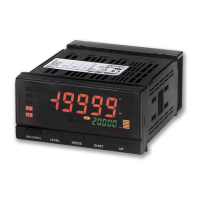
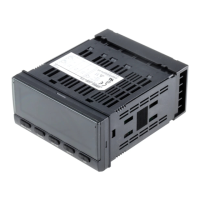
1.1 Main Functions and Features of the K3HB-S
Measurement
Filter
Input compensation
Key operations
Input calculation Timing hold Timing delay
Two measurement values can
be added, subtracted, or the
ratio calculated. In addition,
any constant can be set and
measurement values can be
added to or subtracted from a
constant.
→ P.5-9
Using external timing signal
inputs, synchronous
measurements can be made
and maximum values,
minimum values, and the
difference between maximum
and minimum values can be
measured.
→ P.5-16
Delays starting or ending a for
a set time from the rising or
falling edge of the
measurement signal.
ON and OFF timing can be set
independently.
→ P.5-25
Average processing Previous Average
Comparison
Average processing of input
signals with extreme changes
or noise smooths out the
display and makes control
stable.
→ P.5-30
Removes slight changes from
input signals and detects only
extreme changes.
→ P.5-33
Forced-zero Tare zero Zero-trimming
Forces the present value to 0.
Effective to set a reference
value from which to perform
measurements.
→ P.5-53
Shifts the current value
measured with a forced zero
to 0 again.
Effective, for example, when
two compounds are measured
separately.
→ P.5-54
Compensates for gradual
changes in input signals from,
for example, sensor
temperature drift, based on
OK data (PASS data) at
measurement.
→ P.5-57
Zero-limit Step value
Changes the display value to
0 for input values less than the
set value.
Effective when drift and
displacement of values near
zero need to be eliminated.
→ P.5-28
The step for changing the
value of the rightmost digit of
the measurement value can
be set.
→ P.5-63
Teaching Key protection
During scaling, the input value
during measurement can be
set, as is, as the scaling input
value.
→ P.5-12
(Setting Scaling)
Limits key-operated level and
parameter changes to prevent
inadvertent key operations
and malfunctions.
→ P.5-80


 To Next Page
 Loading...