Safety Features and Equipment
89
HYDRAULIC JACK
To raise
: turn release valve clockwise. Insert
handle in socket and raise by pumping.
To lower
: remove handle and turn the release
valve slowly
counterclockwise.
Always keep ram and extension screw retracted
when jack is not in use.
Service
: Check oil level when jack fails to raise
to full height. Lower ram completely with release
valve open and jack in upright position, remove
filler plug and refill to level of filler hole with
hydraulic jack oil. Never use brake fluid
.
DANGER
Jack is intended for lifting only. Do not get
under the vehicle or load for any reason
unless it is properly supported with safety
stands and securely blocked.
DANGER
Do not load jack above rated capacity. Prevent
"side loading", make sure load is centered on
ram. Do not push or tilt load off jack.
TOWING
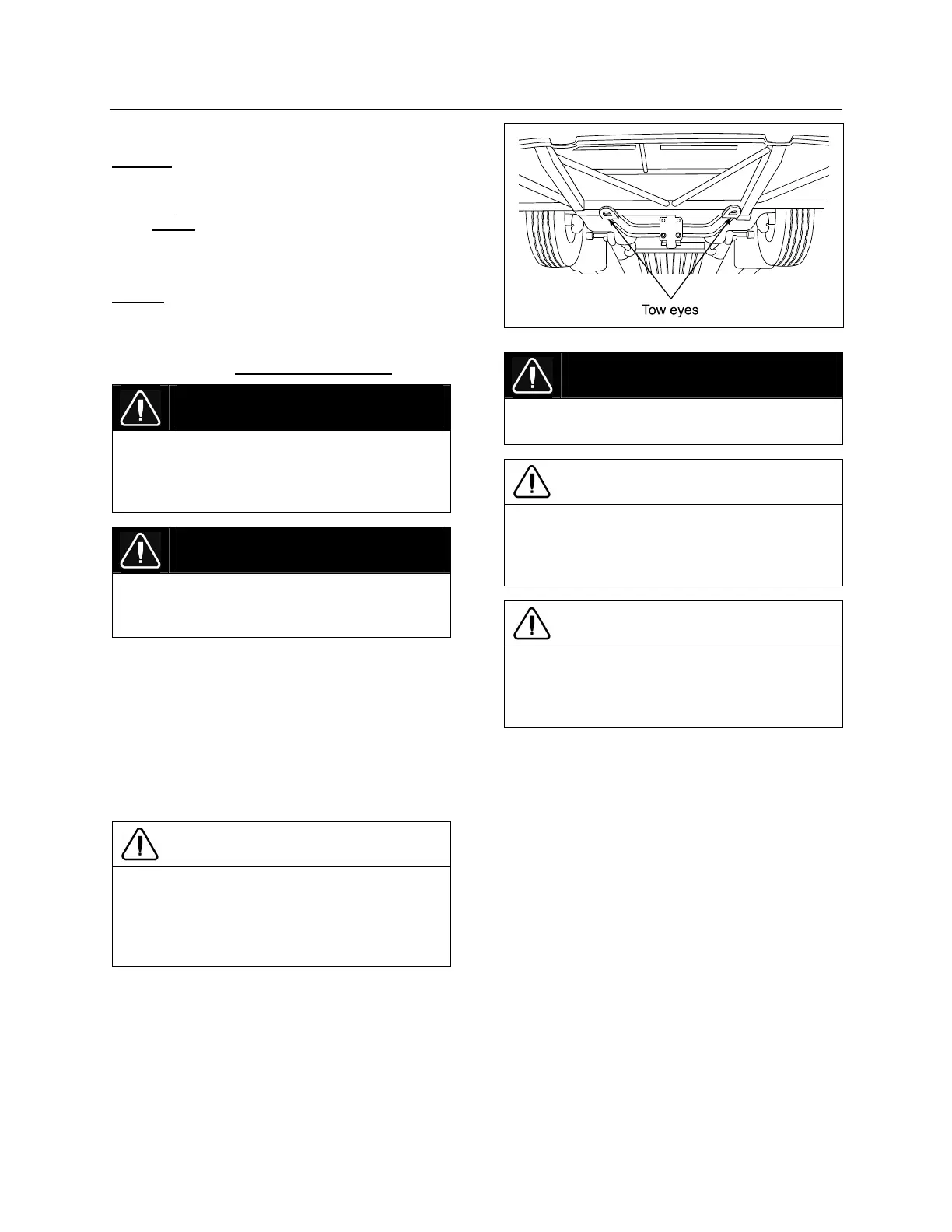
To prevent damage to the vehicle, use the two
tow eyes fixed to the vehicle frame between the
front axle and the front bumper. Use only a solid
link tow bar and a safety chain to tow the
vehicle. If required, connect an auxiliary air
supply to the vehicle so the emergency/parking
brakes don’t apply while towing.
CAUTION
To prevent damage to the vehicle structure, it
is not recommended to tow the vehicle from
the rear. In case of damage to the drive train
components, use a low bed semi-trailer to
support the rear end.
TOW EYES UNDER VEHICLE 18401
DANGER
Do not carry passengers while the coach is
being towed.
CAUTION
To prevent damage to the drive train
components, disconnect axle shafts or
driveshaft before towing. Do not attempt to
push or pull-start the coach.
CAUTION
Make sure axle shafts or driveshaft are
installed correctly after towing. Tighten axle
shaft and driveshaft nuts to the correct torque
settings. Do not invert shafts.
EMERGENCY AIR-FILL VALVES
The vehicle is equipped with two air system
emergency fill valves to supplement the air
system when air pressure is low and the engine
cannot be operated. One valve is located inside
the front service compartment. The other valve
is located inside the engine compartment.
Both air system emergency fill valves are fitted
with standard tire valve stems. The air systems
can be filled using any standard external air
supply line. The fill valve located in the engine
compartment supplies air for all systems
(brakes, suspension and accessories). The fill
valve located in the front service compartment
supplies air for accessories only.




 To Next Page