Operation and Maintenance Manual Rev M(ii) 4/03
- 42 -
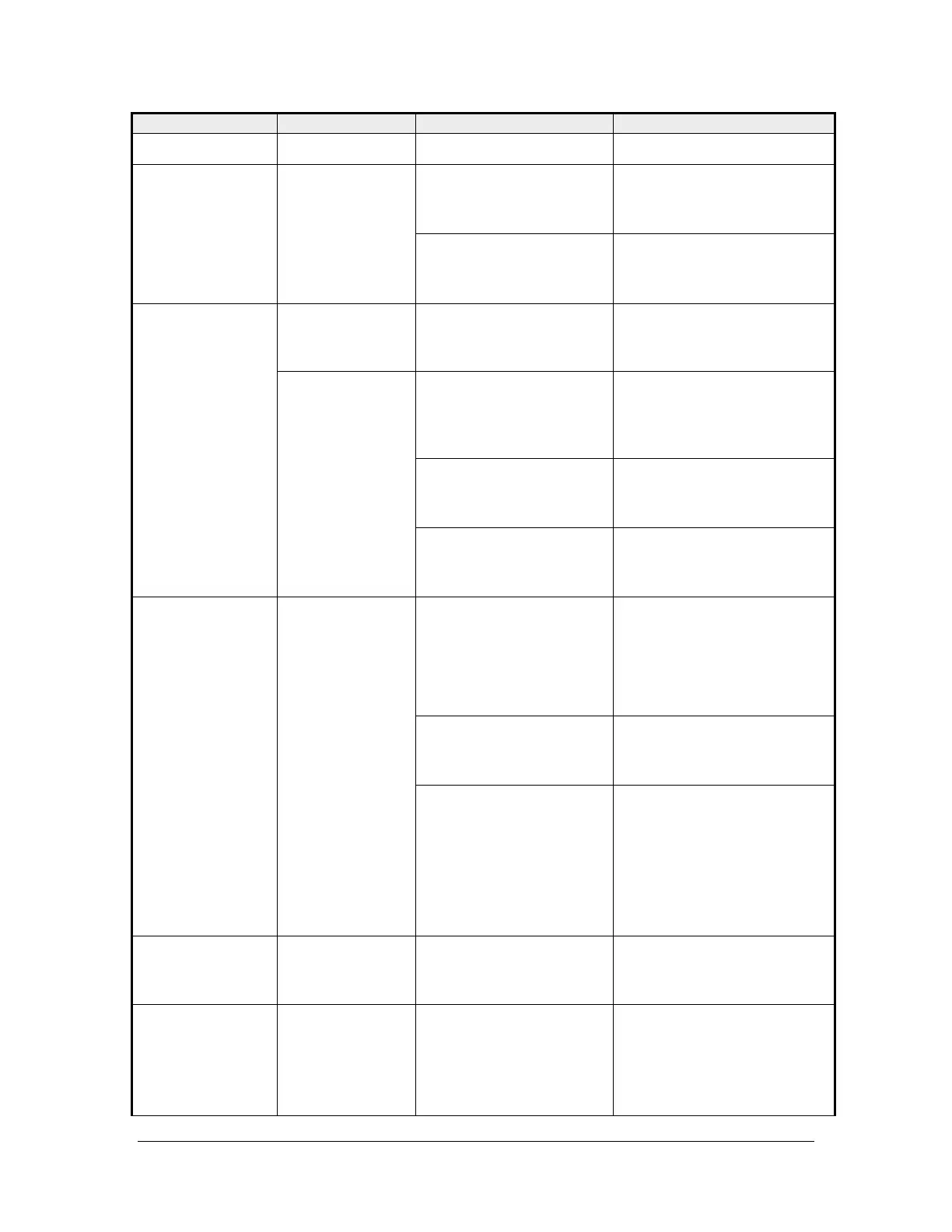
Operation Other Symptoms Possible Cause Corrective Action
on GPIO interface board.
Amp cables are loose or
disconnected
• Check J9 and J11
connections on GPIO
interface board.
Motor Cable(s) are loose or
disconnected
• Verify CPC connections at
motor and terminal
connections on amp.
X, Y or Z axis does
not move.
End effector can be
moved freely when
the power is on.
The EMERGENCY STOP
push button is depressed.
• Release the EMERGENCY
STOP push button.
LCD Screen
indicates that the
system is running
normally.
The amp fuse(s) is blown.
• Check F1-F5 fuses located
on GPIO interface board.
Amp cables are loose or
disconnected
• Check J9, J10 and J11
connections on GPIO
interface board.
Motor Cable(s) are loose or
disconnected
• Verify CPC connections at
motor and terminal
connections on amp.
Axis Looses
position.
The axis speed or
acceleration has been set to
too high.
• Check speed, acceleration
and deceleration settings.
• Refer to Appendix D for
speed, acceleration
deceleration charts.
Coupling is slipping.
• Check coupling connection
at motor and ball screw.
Tighten if needed.
The axis amplifier is bad.
• Replace the amplifier.
Incorrect AC voltage.
• Check the power source
supplied to the workcell.
• Check the power entry
module for correct
configuration.
Pneumatic actuator
failure.
Pneumatics work
slowly.
Air lockout valve on the rear
of the machine is in the OFF
position.
• Turn the lockout valve to
the ON position.
Insufficient air pressure.
• Check and adjust the system
pressures to the correct
values. Please refer to the
Machine Specific
Information section of the
O
eratin
Guide for


 To Next Page