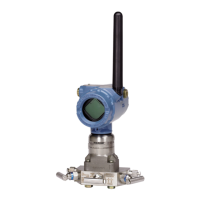
Model 8712C/U/H Magnetic Flowmeter Transmitters
5-6
TABLE 5-3. Flowtube
Troubleshooting
Test A–Flowtube Coil
Step 1 Step 2 Step 3
Disconnect power from the transmitter
by removing the fuse. Disconnect wires
1and2fromthetransmitter.
➤
Measure the resistance across wires 1
and 2 going to the flowtube, using the
lowest ohms scale. The reading should
be between 2 and 18 V.
➤
A reading outside this range indicates
that the coils or cables may be open
or shorted.
Test B– Coil Shield to Coil
Step 1 Step 2 Step 3
Disconnect power from the transmitter
by removing the fuse. Disconnect wires
1, 2, and ground from the transmitter.
➤
Measure the resistance from the coil
shield (ground) to wires 1 and 2 using
the highest scale. Both readings should
be overrange.
➤
Any reading on the scale indicates that
the coils are shorted to the housing.
Test C– Electrode Shield to Electrode (See Note Below)
Step 1 Step 2 Step 3
Disconnect power from the transmitter
by removing the fuse. Disconnect wires
17, 18, and 19 from the transmitter. Test
with process in the flowtube (either flow
or no flow).
➤
Measuretheresistancefromwire17to
18and17to19.Thisreadingwill
change as you hold the leads on the
wires, so use the initial reading.
These readings should both be between
1kV and 3 MV and close to each other.
➤
A reading near 68kV or 0V indicates a
possible shorted electrode. A stable
reading indicates a shorted electrode.
A high reading indicates a possible
coated electrode, non-conductive
process, or electrode not in contact
with process.
Test D– Positive to Negative Electrode (See Note Below)
Step 1 Step 2 Step 3
Disconnect power from the transmitter
by removing the fuse. Disconnect wires
18, and 19 from the transmitter.Testwith
process in the flowtube (either flow or
no flow).
➤
Measure the resistance between wires
18 and 19. This reading should be in the
range between 100 kV and 2MV.
➤
An overrange reading indicates a coated
electrode, non-conductive process,
or electrode not in contact with the
process.


 To Next Page