H.8
SEL-387-0, -5, -6 Relay Instruction Manual Date Code 20170601
Protection Application Examples
Transformer Winding and CT Connection Compensation Settings Examples
Combination of Standard and Non-Standard Phase-to-Bushing
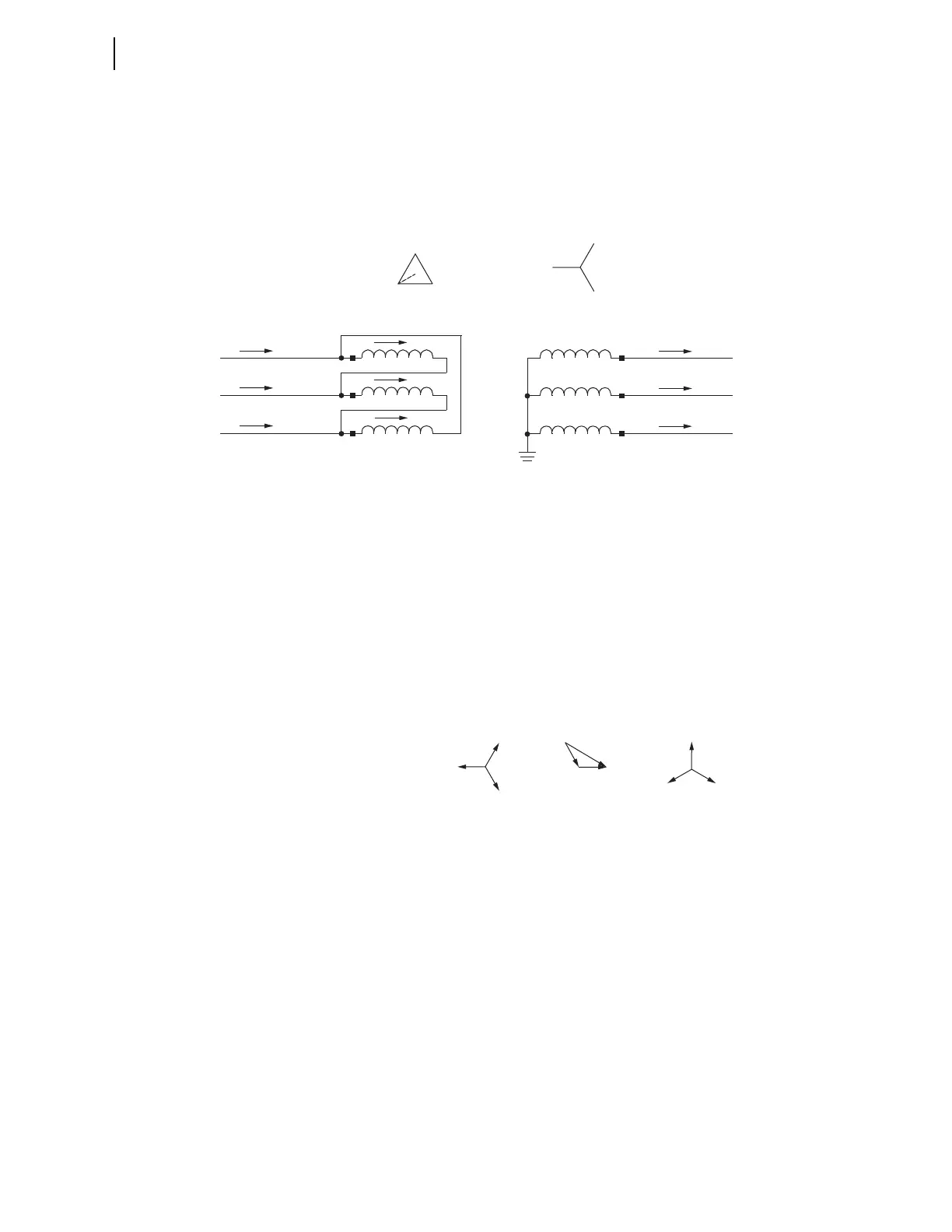
Connections. Consider the transformer connections shown in Figure H.9.
The transformer is the same as in previous examples. However, in this
example, the H-side phase-to-bushing connections are standard: A-phase to
H1, B-phase to H2, and C-phase to H3. The X-side connections are
non-standard: a-phase to X2, b-phase to X3, and c-phase to X1.
Figure H.9 Combination of Standard and Non-Standard Phase-to-Bushing Connection Diagram
Assume balanced X-side (wye-winding) three-phase currents Ia, Ib, and Ic.
Kirchhoff’s Current Law is used at each H-node to determine the primary
phase currents on the H-side of the system:
IA = Ic – Ia
IB = Ia – Ib
IC = Ib – Ic
Figure H.10 shows that system primary current Ia (X-side) lags the system
primary current IA (H-side) by 150 degrees.
Figure H.10 X- and H-Side Current Phasors for Figure H.9
These three examples show that the same transformer winding connections
can produce different phase shifts in the system primary load current based on
the phase-to-bushing connections.
Determine if There Are Non-Standard CT Connections
Figure H.11 shows the transformer of Figure H.2 with a standard current
transformer configuration; that is, both the H-side and X-side CTs are
connected in wye and the polarity marks are away from the power
transformer.
C (H3)
B (H2)
A (H1)
Winding 1 Winding 2
A
B
C
a
b
c
H3
H2
H1
X3
X2
X1
a (X2)
b (X3)
c (X1)
IC
IB
IA
Ib/N
Ia/N
Ic/N
Ib
Ia
Ic
Ic
Ib
Ia
IC
IB
IA
Ic
IA = Ic – Ia
–Ia
X-Side Currents H-Side Currents


 To Next Page