3.5
Date Code 20170601 Instruction Manual SEL-387-0, -5, -6 Relay
Differential, Restricted Earth Fault, Thermal, and Overcurrent Elements
Differential Element
tripping. The function uses the SLP1, SLP2, and IRS1 setting values, along
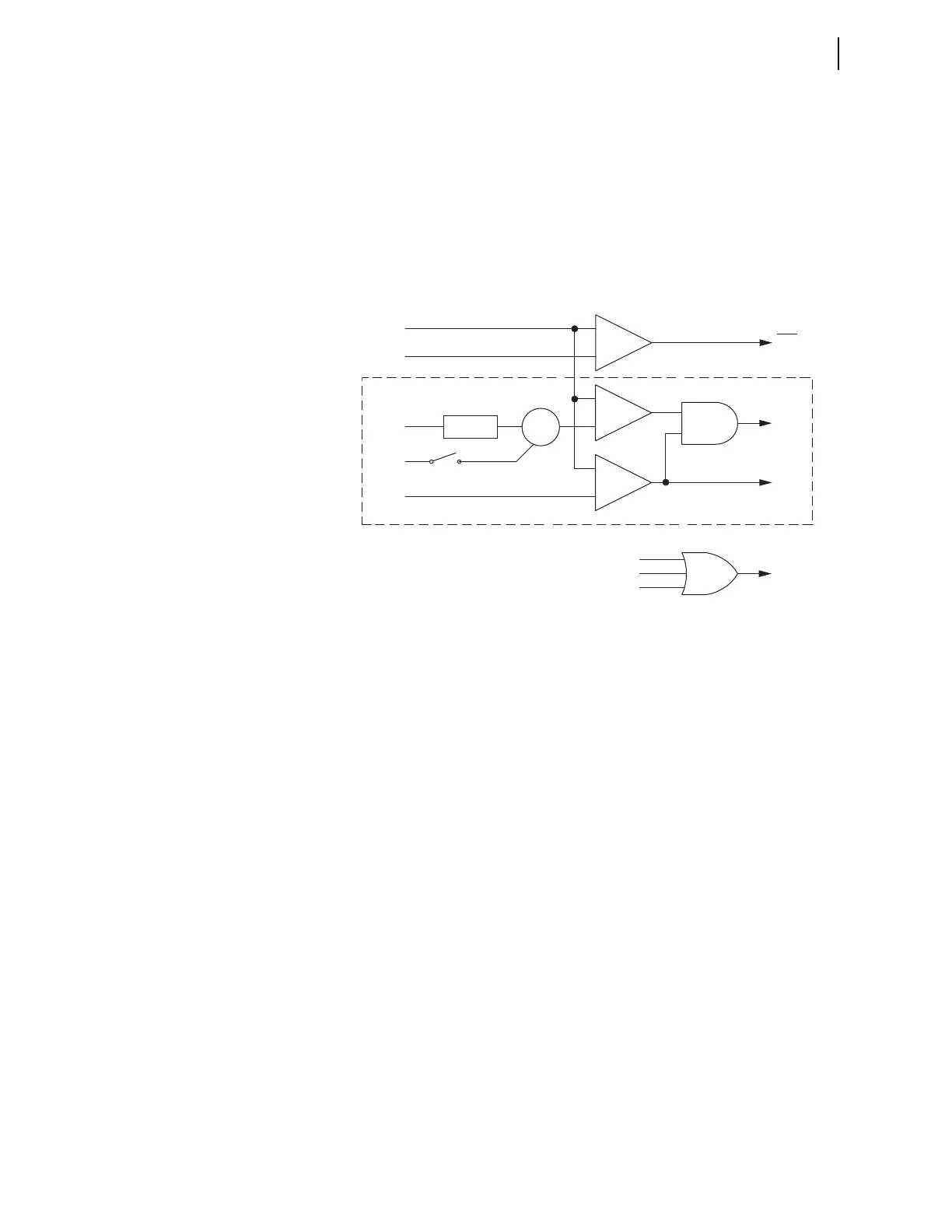
with IRTn, to calculate the IOP value. The differential element decision logic
compares the calculated value, denoted f(IRTn), to the actual IOPn. If IOPn is
greater, one input of the AND gate at the right receives a logic 1. Comparison
of IOPn with the O87P setting determines the second AND input. If IOPn is
greater than O87P, Relay Word bit 87On asserts. The AND gate condition
then is satisfied, and Relay Word bit 87Rn asserts, indicating operation of the
restrained differential element, n. This does not, as yet, produce a trip. The
relay still needs the results of the harmonic and dc blocking decision logic,
which is described later.
Figure 3.5 Differential Element Decision Logic
Harmonic Restraint (All But SEL-387-0)
Consider the harmonic restraint feature (HRSTR = Y) if your practices require
independent harmonic restraint. This feature automatically applies harmonic
restraint to each phase independently. The harmonic blocking setting IHBL is
not used. It also disables second- and fourth-harmonic blocking since it adds
the second- and fourth-harmonic quantities (IHRTn) to the differential
characteristic restraint quantity (see Figure 3.4 and Figure 3.5). Blocking
features are discussed in more detail later in this section.
For harmonic blocking, the harmonic content of the differential current must
exceed the individual (PCT2 or PCT4) threshold values, i.e., the thresholds are
treated as independent measurements of each harmonic value. For harmonic
restraint, the values of the second- and fourth-harmonic currents are scaled by
the respective PCT2 or PCT4 setting before being summed and added to the
relay restraint characteristic (IRTn). Consider, for example, the simple case of
Slope 1, i.e., a straight line through the origin. The general equation for a line is:
Equation 3.1
More specifically, in the SEL-387:
Equation 3.2
IOPn
U87P
(setting)
IRTn
O87P
(setting)
87Un
87Rn
87On
n = 1, 2, or 3
–
+
_
+
_
+
87U1
87U2
87U3
87U
IHRTn
HRSTR = Y
f(IRTn)
Σ
c
Relay
Word
Bits
where:
c = (100/PCT2 * 1WnC2) + (100/PCT4 * 1WnC4)
when:
HRSTR = Y


 To Next Page