48
6.7 Connection of the lubrication line
CAUTION
Risk of slipping
Exercise caution when
handling lubricants.
Immediately remove and bind any leaked
lubricants.
NOTICE
Damage to the higher-level machine caused by
faulty planning of the centralized lubrication system
All parts for the construction of the centralized
lubrication system must be designed for the
maximum operating pressure that occurs, the
permissible ambient temperature range, the required
delivery volume, and the lubricant to be supplied.
Observe the following assembly information for safe and
trouble-free operation:
• Generally valid regulations and company regulations
regarding the laying of pressurized pipe and hose lines
must be observed.
• Use only clean, pre-filled components and lubrication
piping.
• Secure every lubricant line on the pump against
excessive pressure through the use of a suitable
pressure limiting valve (only in the case of pumps
without an internal pressure limiting valve).
• The main lubricant line should be routed on a rising
gradient and should be able to be bled at the highest
point. Lubrication lines should always be arranged so
that air inclusions cannot form anywhere.
• Install lubricant metering devices at the end of the
main lubricant line such that the outlets of the
lubricant metering devices point upwards wherever
possible.
• If the system configuration requires that the lubricant
metering devices be arranged below the main lubricant
line, they should not be placed at the end of the main
lubricant line.
• The flow of lubricant should not be impeded by the
presence of sharp bends, angle valves, flap valves,
seals protruding inward, or changes in cross-section
(large to small). Unavoidable changes in the cross-
section in lubrication lines must have smooth
transitions.
• Connect the lubricant lines in such a way that no
mechanical forces are transferred to the product
(stress-free connection).
• Lubrication piping is to be positioned in such a way
that they cannot become kinked, pinched or frayed.
6.8 Filling with lubricant
6.8.1 Filling via the reservoir cover
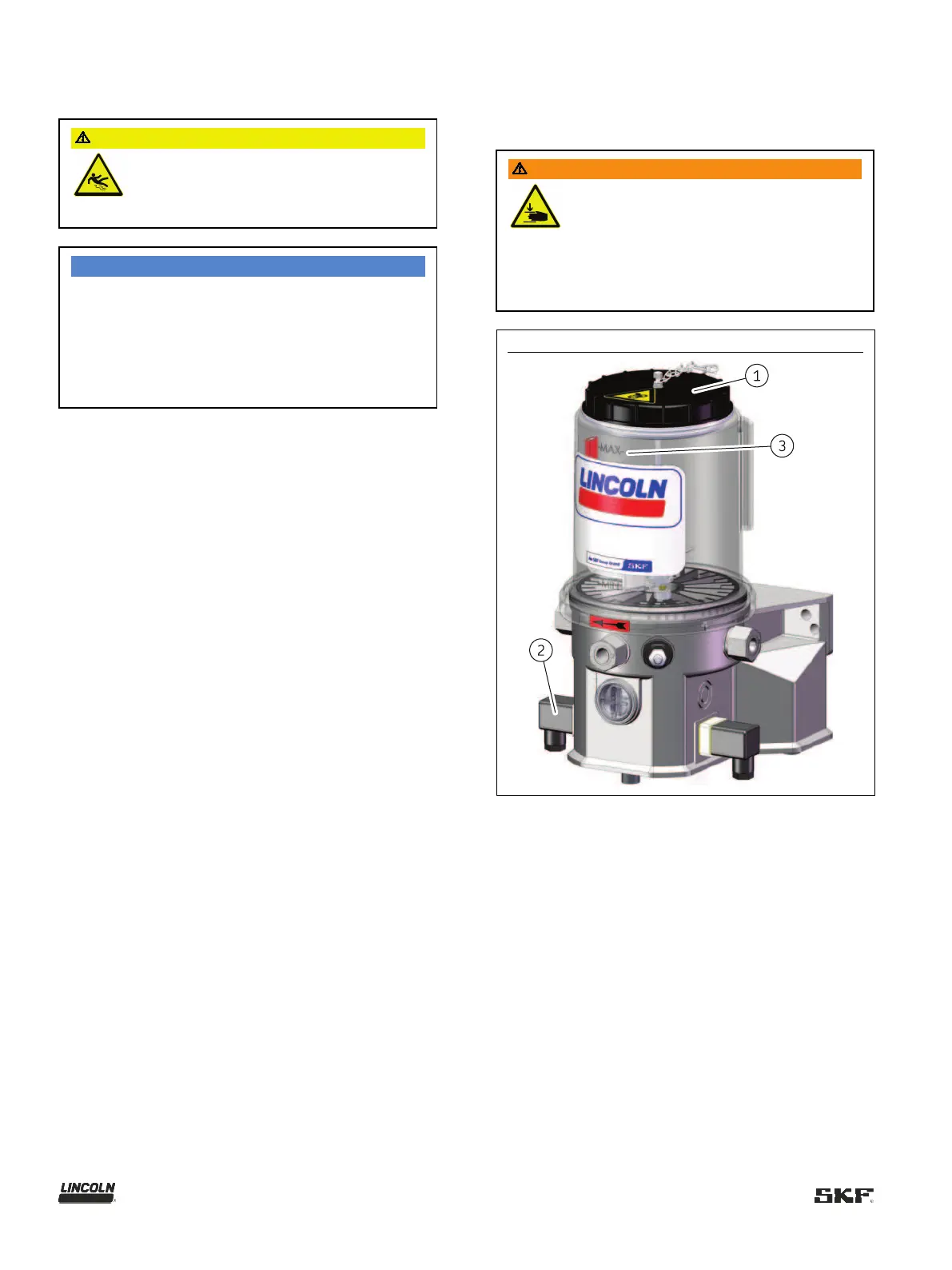
WARNING
Crushing hazard
Crushing hazard on the rotating stirring
paddle. Filling through the opening of the
reservoir lid is permitted only when the pump
has been disconnected
electrically
beforehand by detaching the connection
(Fig.
27/ 2) from the power supply.
Fig.
Filling via the reservoir cover
1. the power supply to the pump by detaching the
connector (Fig. 27/2).
2. Turn the reservoir lid (Fig. 27/1) counterclockwise and
detach it from the reservoir. Set the reservoir cover
down at a clean location. The inner side of the reservoir
cover must not become contaminated. Remove any
contaminations which may be present.
3. Fill the reservoir from the top up to the "MAX" marking
(Fig. 27/3). Take care to ensure while doing so that the
lubricant is filled in without air inclusions if at all
possible.
4. Reinstall the reservoir cover (Fig. 27/1) in clockwise
direction.
5. Restore the power supply to the pump by attaching the
connector (Fig. 27/2) and screwing it firmly in place.




 To Next Page