Engine
7-6
31211015 6036, 6042, 8042, 10042, 10054
7.4.3 Radiator/Oil Cooler and Replacement
Before considering radiator or oil cooler replacement
for other than obvious damage, conduct a cooling
system pressure test, check coolant specific gravity, coolant
level, fan belt tension and dash panel temperature indicator.
• If engine runs hot, check temperature of upper radi-
ator hose.
• If hose is not hot, thermostat may be stuck in closed
position.
• If engine has overheated, performance may
suffer, indicating other damage including a leaking
cylinder head gasket, cracked cylinder head or
block, and/or other internal engine damage.
a. Radiator/Oil Cooler Removal
1. Park machine on a firm, level surface, level machine, fully
retract the boom, lower boom, place transmission in (N)
NEUTRAL, engage parking brake, and shut engine OFF.
2. Place a Do Not Operate Tag on both the ignition key
switch and steering wheel, stating that the machine
should not be operated.
3. Open the engine cover. Allow the system fluids to cool.
4. Properly disconnect the battery(s). Refer Section 9.8,
“Battery”, for procedure.
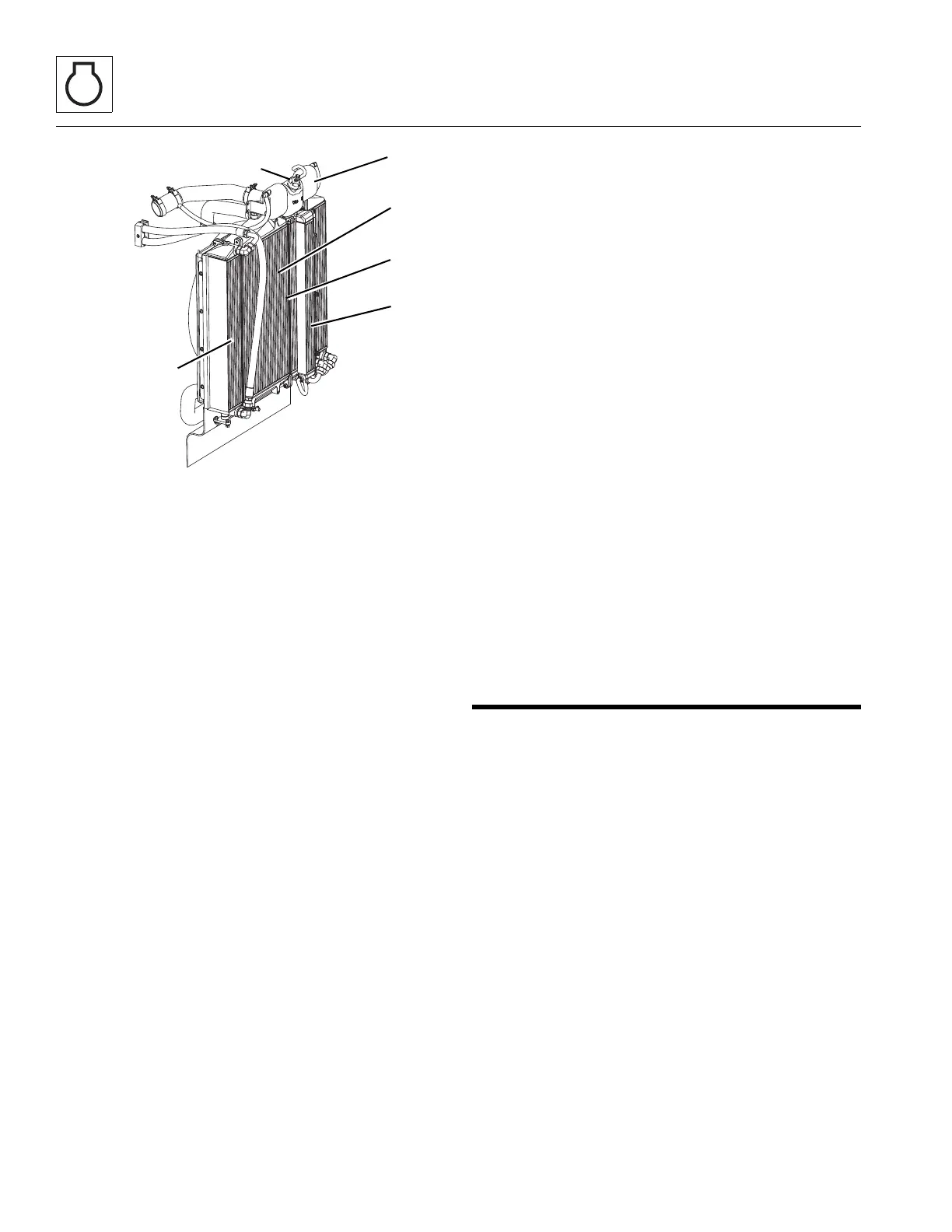
5. Slowly turn surge tank cap (1) to first stop and allow any
pressure to escape. Remove surge tank cap.
6. Place a suitable container beneath radiator drain.
7. Place a funnel at base of radiator to channel drained
coolant into a container. Loosen drain petcock and
slowly allow coolant to drain. Transfer coolant into a
properly labeled container. Dispose of properly if
coolant needs to be replaced. Tighten the radiator drain
petcock.
8. Label and disconnect all hoses and tubes attached to
radiator (2), charge air cooler (3), oil cooler (4), and fuel
cooler (5). Remove surge tank (6).
9. Working at rear of machine, remove cap screws and lock
washers securing radiator assembly.
10. Remove radiator assembly through rear of machine.
b. Radiator/Oil Cooler Installation
1. Secure radiator (2), charge air cooler (3), oil cooler (4),
and fuel cooler (5) to machine frame with previously
used hardware. Reinstall surge tank (6).
2. Uncap and connect the all the previously labeled hoses
and tubes to their appropriate locations.
3. Install the battery or batteries. Connect the battery
positive (+) and negative (-) cables to the appropriate
battery terminals.
4. Fill the radiator completely with coolant and secure cap.
Refer to Section 2.3, “Fluid Specifications”, for proper
capacities.
5. Run engine to operating temperature. Visually check for
leaks with engine running. Check coolant level in
overflow bottle and fill, or drain, as necessary.
6. Close and secure side and rear engine doors.
7.5 ENGINE ELECTRICAL SYSTEM
The engine electrical system, including the starter, alternator
and primary wiring, is described in Section 9, “Electrical
System”.


 To Next Page