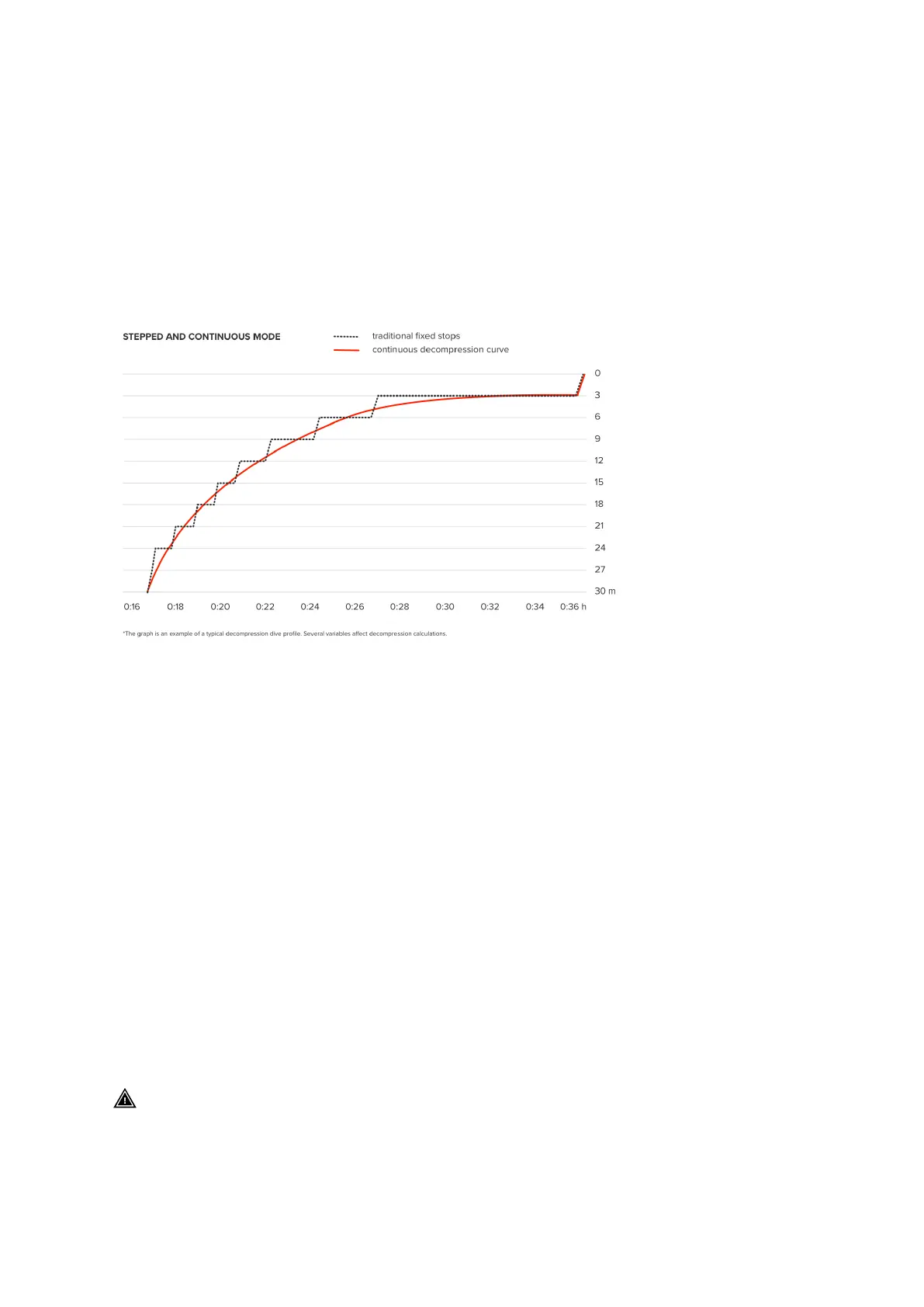
Stepped decompression profile
In this decompression profile, the ascent has been divided into traditional 3 m (10 ft) steps or
stages.
In this model the diver decompresses at traditional fixed depths. The ceiling value in the
switch window will show the depth of the next step and once the diver reaches the
decompression window, a timer starts showing the needed length of the decompression stop.
See 5.8.5. Example - Multigas mode for an example decompression dive.
5.7.4. Altitude setting
The Altitude setting automatically adjusts the decompression calculation according to the
given altitude range. You can
find the setting under Dive options » Algorithm » Altitude and
select from three ranges:
•
0 – 300 m (0 – 980 ft) (default)
•
300 – 1500 m (980 – 4900 ft)
•
1500 – 3000 m (4900 – 9800 ft)
As a result, the allowed no decompression stop limits are considerably reduced.
The atmospheric pressure is lower at high altitudes than at sea level. After traveling to a
higher altitude, you will have additional nitrogen in your body, compared to the equilibrium
situation at the original altitude. This 'additional' nitrogen is released gradually over time and
equilibrium is restored. Suunto recommends that you acclimatize to a new altitude by waiting
at least three hours before making a dive.
Before high-altitude diving, you need to adjust the altitude setting of your dive computer so
that the calculations take into account the high altitude. The maximum partial pressures of
nitrogen allowed by the mathematical model of the dive computer are reduced according to
the lower ambient pressure.
WARNING: Traveling to a higher elevation can temporarily cause a change in the
equilibrium of dissolved nitrogen in the body. Suunto recommends that you acclimatize to the
new altitude before diving. It is also important that you do not travel to a significantly high
altitude directly after diving to minimize the risk of DCS.
Suunto Ocean
63



 To Next Page