•
The displayed oxygen exposure calculations are raised to the next higher percentage
value.
•
The CNS% limits up to 1.6 bar (23.2 psi).
•
The OTU monitoring is based on the long-term daily tolerance level and the recovery rate
is reduced.
At the surface and after the dive has ended, the CNS decreases with a half time of 90 min.
For example, if the CNS is 100 after the dive, 90 min later it will be decreased to 50 and then
after another 90 min to 25.
WARNING: WHEN THE OXYGEN LIMIT FRACTION INDICATES THAT THE MAXIMUM
LIMIT IS REACHED, YOU MUST IMMEDIATELY TAKE ACTION TO REDUCE OXYGEN
EXPOSURE. Failure to take action to reduce oxygen exposure after a CNS%/OTU warning is
given can rapidly increase the risk of oxygen toxicity, injury, or death.
Ceiling
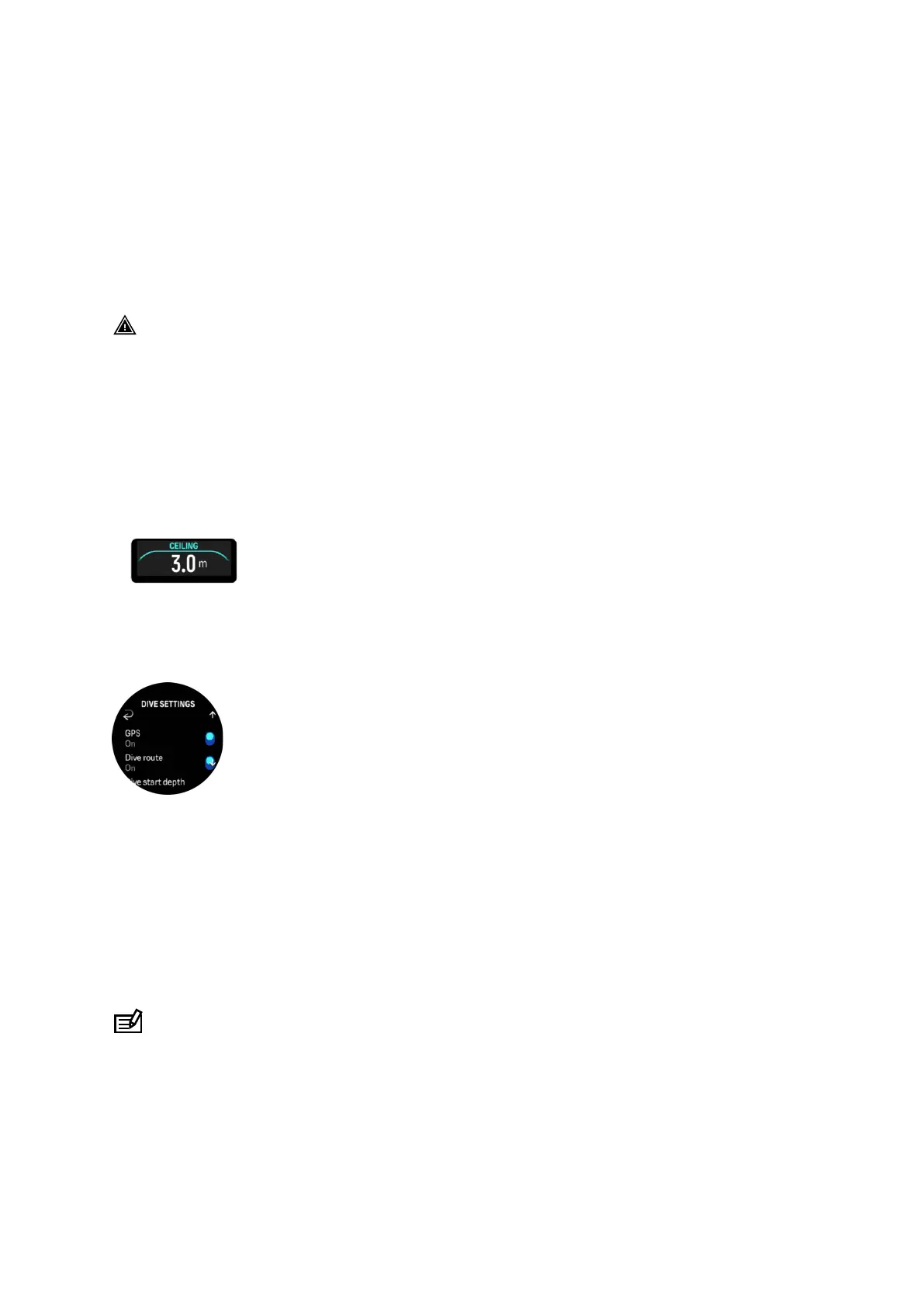
When mandatory decompression stops are required, a ceiling value appears in the switch
window. Suunto Ocean shows the ceiling value always from the deepest stop. You must not
ascend above the ceiling during your ascent. Read more about decompression diving in
5.8.2. Decompression dives.
5.3. Dive settings
For Dive settings, scroll down from the pre-dive screen.
Heart rate
Turn heart rate measurement on or o for your dive. See more about heart rate in the 9.4.
Heart rate, 2.5. Optical heart rate and 4.11.1. Heart rate zones topics.
GPS
To track the start and end point of your dive and to get a more accurate dive route, you need
to enable GPS in the Dive settings. Make sure the GPS arrow icon turns green in the pre-dive
screen before starting your dive to get an accurate location. Suunto recommends you always
start your dive from the pre-dive screen.
NOTE: If you start your dive from any other screen utilizing the automatic start function,
the GPS signal won’t be found.
Dive route
You can track your dive route with Suunto Ocean. The underwater route tracking is based on
GPS, accelerometer, gyroscope, magnetometer and pressure sensor. The algorithm has been
developed by using large amount of data from real dives, data analytics and machine
learning.
Suunto Ocean
47



 To Next Page