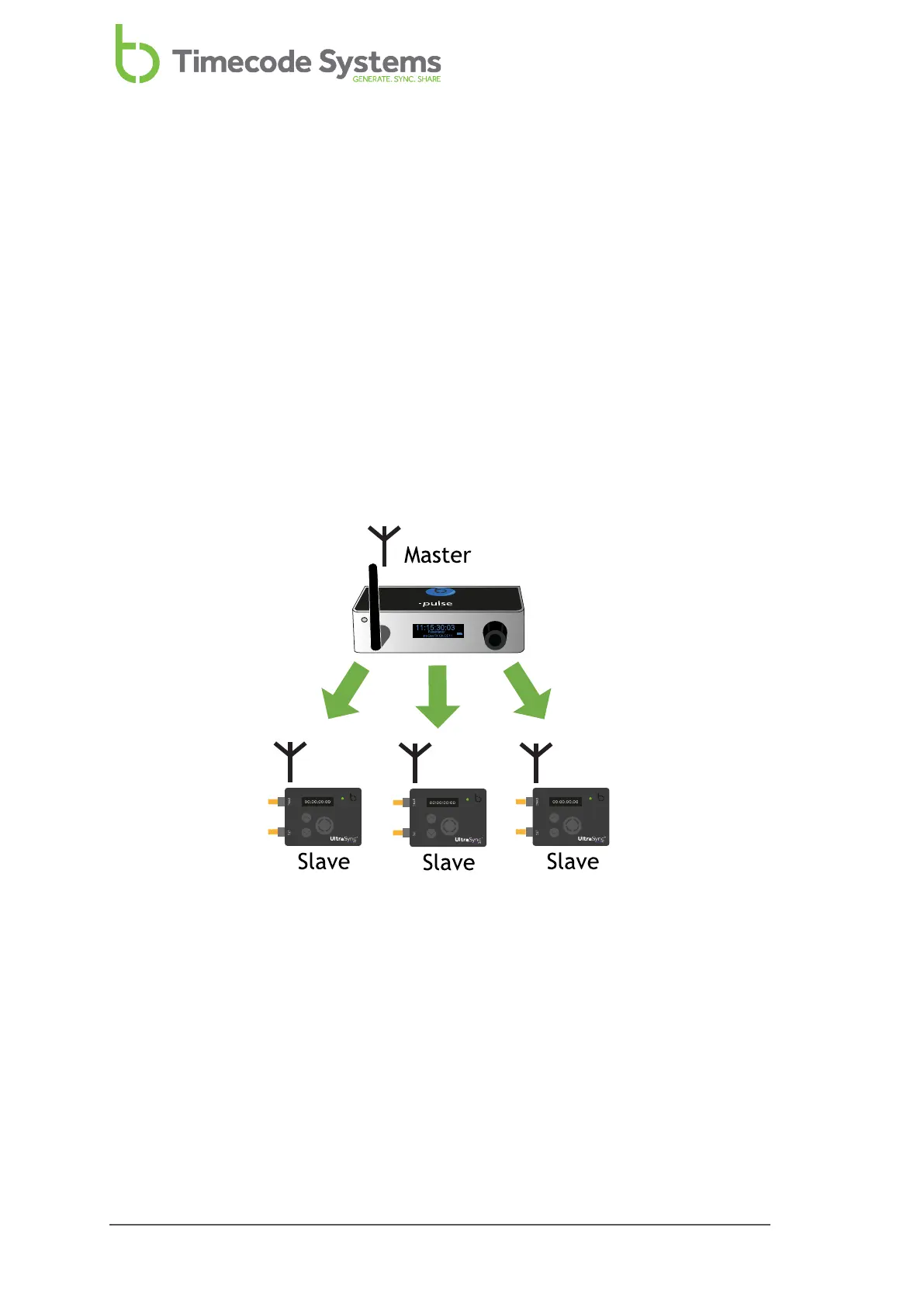
Master and Slaves
To synchronise two or more Timecode Systems products, they need to be in the
same network. In the network, one device has to be set to run as the master, and
the other devices have to be set to run as slaves.
The master is the dominant device, and it can either:
l Generate the timecode and pass it to all other connected devices
l Receive and retransmit the timecode.
The master sends its timecode data to the slaves (via radio). When the slaves
receive the timecode, they change their own timecode settings to match.
The slaves communicate with the master regularly, to make sure they remain
synchronised.
In the image shown, the UltraSync ONE units are set to run as slaves and the master
is a Timecode Systems:pulse. In an RF network, your UltraSync ONE can run as a
slave or as a master, but in a BLINK network, it can only be used as a slave.
If a slave is out of range of the master, it will free-run (see What if a Slave Cannot
Find a Master? on page 26).
The master and slave relationship is used in both the RF Network (see page 29) and
the BLINK Network (see page 31).
24 UltraSync ONE User Guide


 To Next Page