Need help?
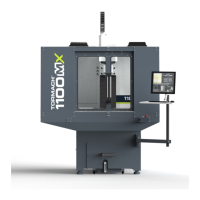
Do you have a question about the Tormach 1100MX and is the answer not in the manual?
Introduces machine tool dangers, emphasizes understanding safety messages, decals, and information.
Details general shop safety, operational safety, electrical safety, and noise exposure precautions.
Outlines requirements for location, power, air, lighting, temperature, and humidity.
Specifies primary power, circuit amperage, electrical noise, grounding, and plug requirements.
Details the installation of essential components like the Y-axis, controller, and oiler.
Guides on loading, editing, reading G-code files, and using conversational programming.
Details how to use a probe with PathPilot for feature location and offset setting.
Explains how to bring the machine out of reset, jog, reference, and start/stop programs.
Covers functions like feed hold, overrides, single block mode, and changing feed/spindle speed.
Steps for powering on the machine and PathPilot controller.
Procedure to establish known positions for machine axes and verify clear travel.
Explains how to switch between continuous and step jogging modes using keyboard or jog shuttle.
Procedures for touching off tool offsets using reference surfaces or an electronic tool setter.
Explains how to set axis locations to zero for work coordinate systems and naming conventions.
Procedures for setting the Z zero and establishing X/Y work offsets using a tool.
Guides on touching off tool offsets, measuring tools using reference height or ETS.
Steps to create a pocket and engrave text, including running the program and verifying results.
General safety guidelines for performing maintenance procedures on the machine.
Safety precautions to take before and during troubleshooting procedures.
Troubleshooting steps for electrical issues, including power distribution and control power subsystems.
 General
| Z Travel | 16.25 in (413 mm) |
|---|---|
| Spindle Speed | 10, 000 RPM |
| Control | PathPilot |
| Spindle Taper | R8 |
| X Travel | 18 in (457 mm) |
| Y Travel | 11 in (279 mm) |
| Table Size | 9.5 in |
| Max Table Load | 500 lbs |
| Power Requirements | 220 VAC, single-phase, 30 A |

 To Next Page