EasyManua.ls Logo

TP-Link TL-SG5426 - User Manual

TP-Link TL-SG5426
499 pages
Print Icon
To Next Page IconTo Next Page
Loading...
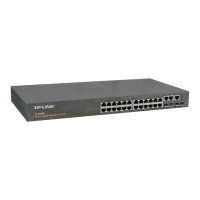
TL-SG5426
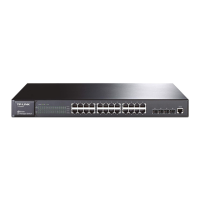
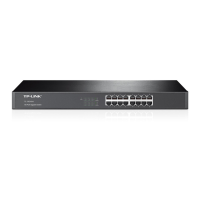
26-Port Gigabit Managed Switch
Rev: 1.0.0
1910010105

Table of Contents

Questions and Answers

  • S
    Susan DuranAug 10, 2025
    Why I cannot connect to TP-Link Switch using Secure Shell (SSH)?
    • D
      Donald MooreAug 10, 2025
      If you're unable to connect to your TP-Link switch using SSH, consider these potential solutions: * You might have exceeded the maximum number of concurrent Telnet/SSH sessions permitted. Wait a while and try connecting again. * Ensure the SSH server's control parameters are correctly configured on the switch, and that the SSH client software is properly configured on your management station. * Confirm that you've generated a public key on the switch and exported it to the SSH client. * Verify that you've set up an account on the switch for each SSH user, including the username, authentication level, and password. * If using public key authentication, make sure you've imported the client's public key to the switch.
  • A
    Alice FernandezAug 19, 2025
    How to access TP-Link Switch configuration program via serial port if I cannot connect?
    • M
      Mallory SandersAug 19, 2025
      If you're having trouble accessing the on-board configuration program of your TP-Link switch via a serial port connection, verify the following: * Ensure your terminal emulator program is set to VT100 compatible, with 8 data bits, 1 stop bit, no parity, and 9600 bps. * Check that the null-modem serial cable conforms to the pin-out connections provided in the Installation Guide.
  • J
    Jennifer MillsOct 30, 2025
    What to do if I cannot connect to TP-Link Switch using Telnet, web browser, or SNMP software?
    • M
      Monique LoganOct 30, 2025
      If you're having trouble connecting to your TP-Link switch via Telnet, a web browser, or SNMP software, here are a few things to check: * First, make sure the switch is powered on and that the network cables between your management station and the switch are properly connected. * Verify that you have a valid network connection to the switch and that the port you're using hasn't been disabled. * Ensure the VLAN interface through which your management station connects has a valid IP address, subnet mask, and default gateway configured. * Confirm that the management station's IP address is in the same subnet as the switch's IP interface. * If connecting via a tagged VLAN group's IP address, ensure your management station and intermediate switch ports are configured with the correct...

Summary

Chapter 1: Introduction

Key Features

Lists key features of the switch, including configuration backup, authentication, and access control lists.

Description of Software Features

Details advanced performance features like flow control, broadcast storm suppression, VLANs, and QoS.

Chapter 2: Initial Configuration

Connecting to the Switch

Explains how to connect to the switch using CLI, Telnet, web interface, and SNMP management.

Basic Configuration

Covers console connection, setting passwords, and configuring IP addresses manually or dynamically.

Chapter 3: Configuring the Switch

Using the Web Interface

Details how to use the embedded HTTP web agent to configure the switch and monitor network activity via a web browser.

Setting the Switch’s IP Address

Describes how to configure an IP interface for management access over the network, including manual and dynamic methods.

Configuring Port Security

Covers enabling port security to control access based on MAC addresses and actions upon violation.

Configuring 802.1 X Port Authentication

Explains the IEEE 802.1X standard for port-based access control using user credentials.

Access Control Lists

Describes ACLs for packet filtering based on IP or MAC addresses, and the process of creating and binding them.

Port Configuration

Covers displaying connection status, port information, trunk information, and configuring port settings.

Spanning Tree Algorithm Configuration

Covers configuring STA to detect and disable network loops and provide backup links.

Chapter 4: Command Line Interface

TP-Link TL-SG5426 Specifications

General IconGeneral
Switching Capacity52 Gbps
MAC Address Table16K
Standards and ProtocolsIEEE 802.3, IEEE 802.3u, IEEE 802.3ab, IEEE 802.3z, IEEE 802.3x, IEEE 802.1D, IEEE 802.1w, IEEE 802.1s, IEEE 802.1Q, IEEE 802.1p
Forwarding Rate38.7Mpps
Jumbo Frame9KB
Power Supply100-240V AC, 50/60Hz
Dimensions (W x D x H)440 x 220 x 44 mm
MountingRack Mountable
Operating Temperature0°C to 40°C
Storage Temperature-40°C to 70°C
Operating Humidity10% to 90% non-condensing
Storage Humidity5% to 90% non-condensing

Related product manuals