Mobile Belt Loader Model 660 Safety
Operation Manual
Safety - 2 - 20 CD397-Oper
• Do not leave any vehicle unattended with its engine running.
• Do not drive GSE with lifting devices in the raised position, except for final positioning of
the GSE onto the aircraft.
• Do not allow any GSE such as tractor, pallet transported, baggage/cargo carts and dollies
to move or be positioned under the aircraft fuselage.
• Do not move any GSE towards the aircraft unless all of the following criteria are met:
a. Aircraft has come to a complete stop;
b. Engines have been switched off and are spooling down;
c. Anti-collision lights are switched off;
d. Wheel chocks are positioned;
e. Ground/Flight Crew communication has been established, and clearance has
been given, if applicable.
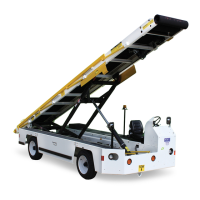
2.3.3BeltLoaderAircraftLoadingEquipment
The following precautions must be taken when operating a belt loader:
• The boom of the belt loader must never be positioned inside the cargo hold of any air-
craft.
• Position and remove a belt loader in a straight line with the cargo hold door at a 90
degree angle to the aircraft fuselage.
• Make sure the boom is clear of the aircraft or other obstacles before making a turn.
• The rubber bumpers on a conveyor belt loader must NEVER make contact with the air-
craft. The minimum distance to be maintained at all times is 1 in. (2.5 cm) from the fuse-
lage.
• Always raise side handrails as soon as belt loader is positioned. Make sure they do not
touch the aircraft fuselage.
• Specially designed belt loaders (e.g. Ramp Snake or Powerstow) require the equipment
to be positioned inside the cargo hold.
• Do not sit or stand on a conveyor belt while it is in operation (up or down).
NOTE:
The above does not apply for ground power units (GPUs).


 To Next Page