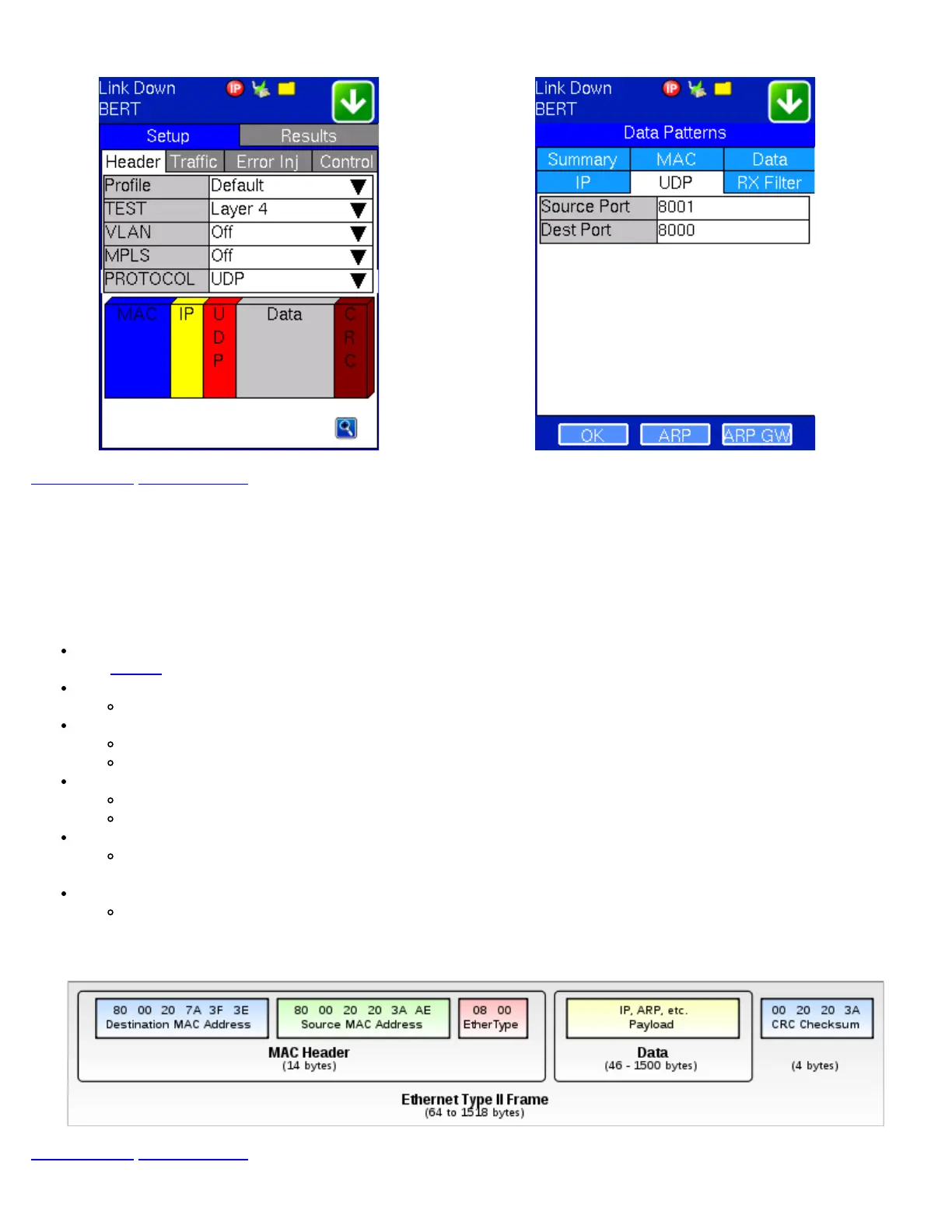
BERT Setup - Header (Layer 4) BERT Setup - Header (Layer 4) UDP Settings
Go back to top Go back to ToC
7.1 BERT Setup
The test layer, frame header, traffic profile, error injection, and control settings of the far-end device (if applicable) must be
configured prior to testing.
7.1.1 Header Settings
BERT Profile: Load a previously configured test profile or create a new profile from existing settings.
See
Profiles for more details on how to create new profiles.
Test: Select the test layer to perform the BERT.
Options are Layer 1 Framed, Layer 2, Layer 3, and Layer 4.
Frame Type: Select the Ethernet frame type for Layer 2 or Layer 3.
802.3 Raw (IEEE 802.3 frame without LLC) - Not available when Layer 3 is selected
Ethernet II (DIX) (named after DEC, Intel, and Xerox, this is the most common frame type today)
MAC/IP: Tap the MAC and IP blocks on the Frame image to access the setup menus
Set the Source and Destination MAC address for Layer 2
Set the Source and Destination MAC and IP addresses for Layer 3
VLAN: Off, 1 tag, 2 tags, 3 tags.
The user is able to configure up to 3 VLAN tags (VLAN stacking, for Q-in-Q applications)
Note: VLAN stacking is an option.
MPLS: Off, 1 tag, 2 tags, 3 tags.
The user is able to configure up to 3 MPLS tags.
Note: MPLS tag configuration is only available when the MPLS option is purchased.
The most common Ethernet Frame format, Type II
Go back to top Go back to ToC
MAC, VLAN, MPLS, IP, and Test Pattern Configurations:
TX130M+_e-manual_D07-00-051P_RevD00


 To Next Page