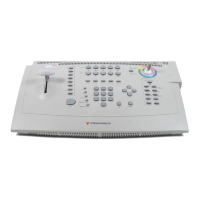
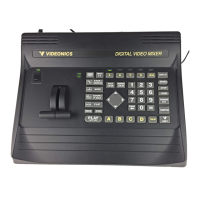
MXPRODV USER GUIDE CHAPTER 4
44
STARTING AND STOPPING MXPRODV
Press the Power switch to start or stop MXProDV. The switch, located on the right-
end of the unit, is a rocker-type switch.
UNDERSTANDING THE KEYBOARD
Use the MXProDV keyboard to control how the unit operates.
This section briefly describes the button groups and, in some cases, individual but-
tons and controls. Additional information appears throughout this User Guide.
Some of the following descriptions provide a reference to the page where you can
find details. Refer to the illustration on the next page while reading this material.
1 T-Bar (or, Take Bar) — Use to manually control the way transitions run, tile size in PIP
mode, and audio levels in the Audio Mixer. See Chapter 5, Transitions, Chapter 8,
PIPs, and Chapter 12, Working with Audio, respectively.
2 Function Buttons — Provide immediate access to built-in functions, including
DIS-
PLAY
, SETUP, ROUTE, LEARN, COMPOSE, PIPS, AUDIO MIX, and FREEZE. You can also access
the built-in demo using these buttons. See Chapter 7, Functions, for details.
3 Source Selectors — Use to select the CURRENT (
CUT) and NEXT sources for a produc-
tion. Normally, you select the CURRENT and NEXT sources, select a transition to use
between the two, then run it. For example, you might select a camcorder as one
input source (CURRENT) and a VCR as the other (NEXT). You then select a transition,
such as a dissolve or wipe. When you reach the point in the CURRENT source where
you want to change to the NEXT source, press
PLAY or use the T-BAR to instruct
MXProDV to play the transition. The CURRENT source becomes the new NEXT
source, and the old NEXT source becomes the new CURRENT source. (See “Using
CURRENT and NEXT Sources” beginning on page 49.) Use the
COLOR buttons to cre-
ate solid colored backgrounds and other effects. (See “Working with Colors” begin-
ning on page 53.)
4 Video/Audio Selector — Determines whether VIDEO, AUDIO, or both VIDEO and
AUDIO are affected when you run a transition. When set to
VIDEO, the video changes
but the audio does not. When set to
AUDIO, the audio changes but the video does
not. When set to both, the video and audio both change. See “Using the Video/Audio
Selector” on page 51.
5 Joystick — Provides an easy way to make fine adjustments to various components.
For example, when using PIPs, the joystick positions the various picture elements on
the screen. When using color correction, the joystick adjusts the color. The joystick
has other uses you’ll learn about in later chapters.
6 Power Switch — This component is located on the right-hand side of the unit, not
on the top. The Power switch is a rocker-type switch for turning the unit on and off.
7 Transition Category Buttons — Gives you immediate access to the five, major cate-
gories of transitions, including
USER, BASIC, EDGES, TRAILING, and SHAPES. All MXProDV
transitions fall into one of these categories. After pressing a button, you can search
through the transitions in that category to find the one you want to use. See “Transi-
tion Categories and Menus” beginning on page 64.
8 Play Button — Press to perform the cut or transition you have set up. In other words,
set up your CURRENT and NEXT sources, select a transition, then press
PLAY at the
moment you want MXProDV to perform the step.


 To Next Page