7 Troubleshooting | 7.1 Chamber ZEISS
7.1.6.1 Replacing the O-ring
WARNING
Suffocation hazard due to lack of oxygen
Gaseous dry nitrogen is used to vent the specimen chamber during specimen exchange. Inhal-
ing nitrogen may cause unconsciousness.
4 During specimen exchange, keep the chamber door open as short as possible.
4 Do not inhale the air from within the specimen chamber.
4 Ensure that the area around the microscope is sufficiently ventilated.
4 If you begin to experience symptoms of asphyxia (for example: rapid breathing, loss of
mental alertness and/or muscular coordination, depression of sensations, emotional insta-
bility, fatigue) leave the room immediately and inform the facility’s safety officer.
CAUTION
Moving the specimen stage
Fingers can be trapped by the moving specimen stage.
4 Always close the chamber door before moving the specimen stage.
4 To remove parts fallen into or near to the stage use a tool (e.g. tweezers) instead of your
fingers.
CAUTION
Closing the chamber door
Fingers can be pinched when closing the chamber door.
4 Ensure not to get your fingers caught in the chamber door gap.
NOTICE
Contamination caused by fingerprints
Contamination caused by fingerprints can lead to vacuum deterioration or prolonged pumping
times.
4 Always wear lint-free gloves when touching the specimen, specimen holder, or stage.
Procedure
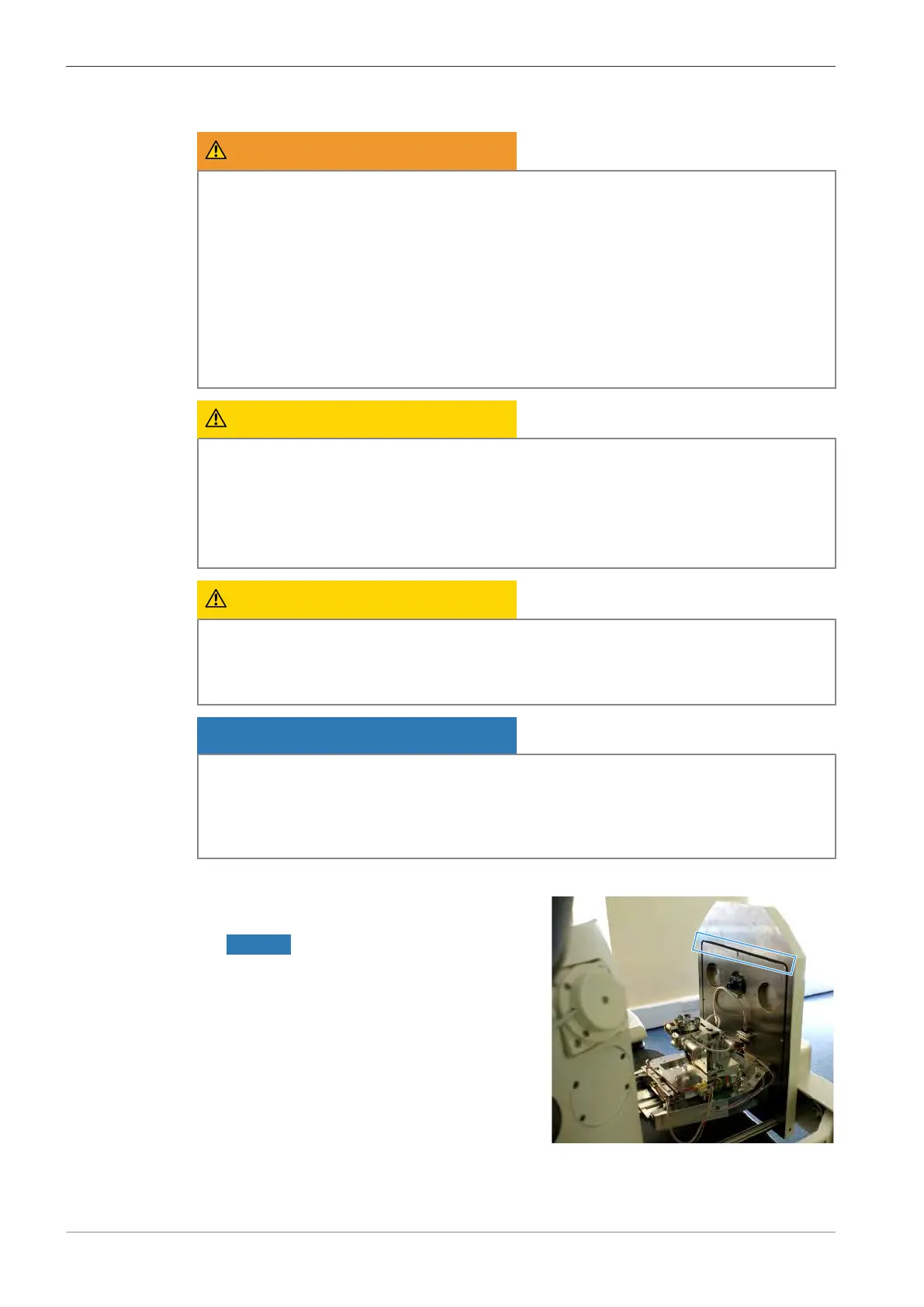
1. Carefully open the chamber door.
2. On the inside of the chamber door, remove the
chamber door O-ring.
NOTICEIf you use a metal tool to re-
move the O-ring, then you may damage
the sealing surface. If necessary, then only
use a plastic or wooden tool to remove
the O-ring.
3. Inspect the groove that holds the O-ring and remove any contamination.
4. Insert the new chamber door O-ring.
5. Close the chamber door.
118 Instruction Manual ZEISS EVO | en-US | Rev. 10 | 354706-0780-006


 To Next Page