3.12 Air intake system
3.12.1 Checking the air cleaner
The engine performance and length of service life depend to a great extent on the state of the air cleaner.
A defective air cleaner allows impurities to pass through, which in time damages the turbocharger and the
engine. A blocked air cleaner reduces the engine output and also causes oil leakage through the sealing
ring on the turbocharger shaft.
See the instructions of the machine manufacturer for checking or cleaning the air cleaner.
3.12.2 Checking the inlet and exhaust pipes
NOTE: Leaks in the inlet or exhaust system
drastically reduce the effect of the turbocharger.
Because of the pressure, even small leaks in the
manifold or the turbine inlet contact flange quickly
increase in size. For this reason, all leaks must be
dealt immediately.
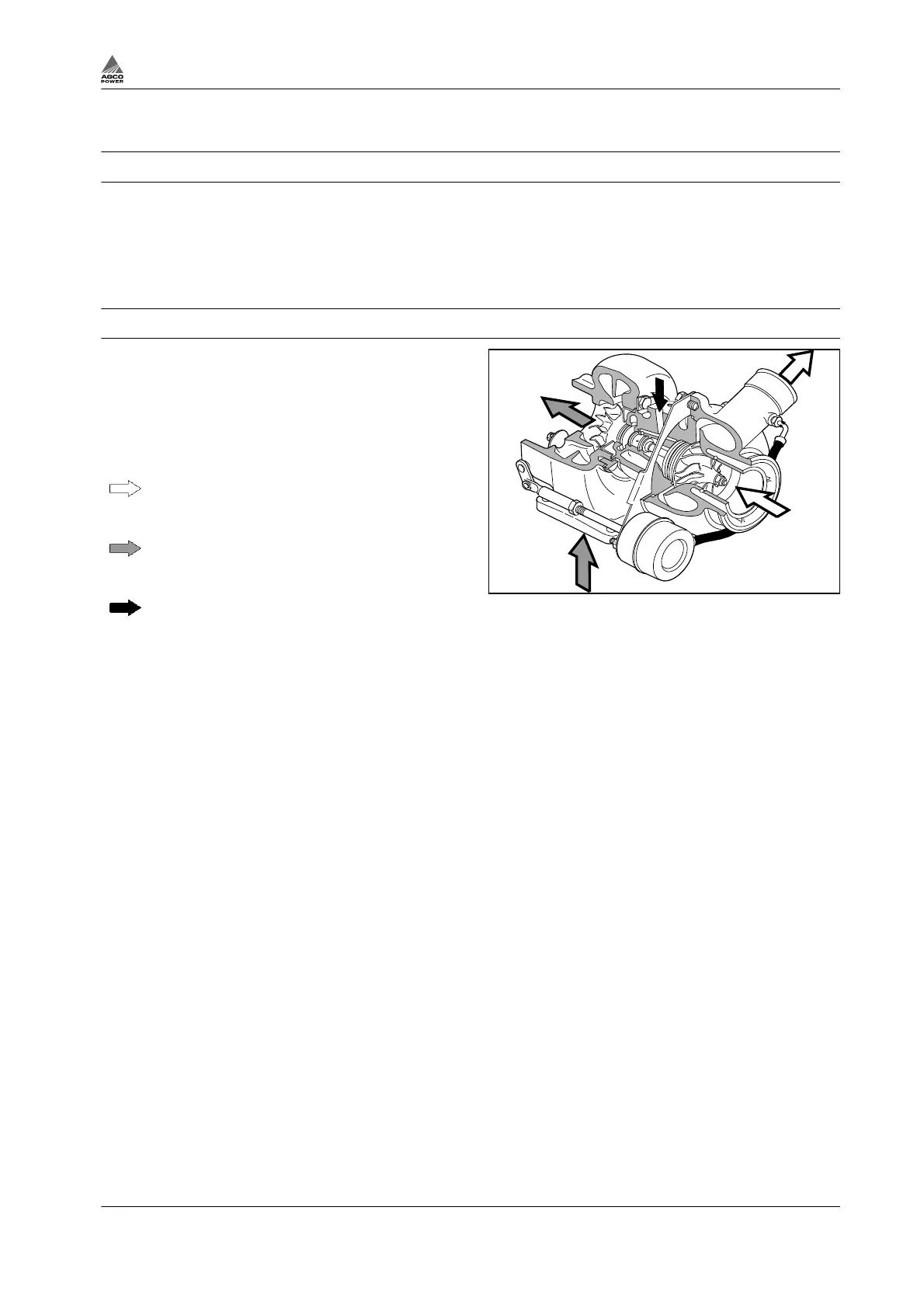
Inlet air
Exhaust gases
Lubrication oil
Fig. 96
Procedure
1.
Inspect the pipes and sealing surfaces between the air cleaner and the turbocharger, as well as
between the turbocharger and the intake manifold.
If the intake manifold is dusty inside, there is a leak in either the air cleaner or the inlet pipes. Fix the
leak.
2.
Clean the intake manifold sealing surface.
a)
Check that the sealing surface is flat using a straight ruler.
b) Machine or renew the intake manifold, if the sealing surface is not flat or the sealing surface has
scratches on it.
3.
Ensure that the cylinder heads are parallel (66, 74, 84 and 98 engines).
4.
Fit a new gasket and fasten the intake manifold.
Tighten the intake manifold fixing screws to 30 Nm.
5.
Fasten the air pipes carefully.
6.
Check that the exhaust manifold is airtight.
a) Tighten the exhaust manifold nuts to 50 Nm.
b) Inspect for any damage (cracks, deformation, corrosion etc.)
c) Check the connection between the turbocharger and the exhaust manifold.
7.
Remove the exhaust manifold if necessary.
a) Clean the sealing surfaces and remove any carbon deposits.
b) Check that the sealing surfaces are flat.
c) Machine the fastening flanges or renew the exhaust manifold, if the fastening flanges are twisted
or there are scratches on the sealing surfaces.
8.
Ensure that no loose objects or impurities have entered the exhaust pipe or the silencer.
3. Maintenance
4th Generation Engines 3-57
8370 79492



 To Next Page