19
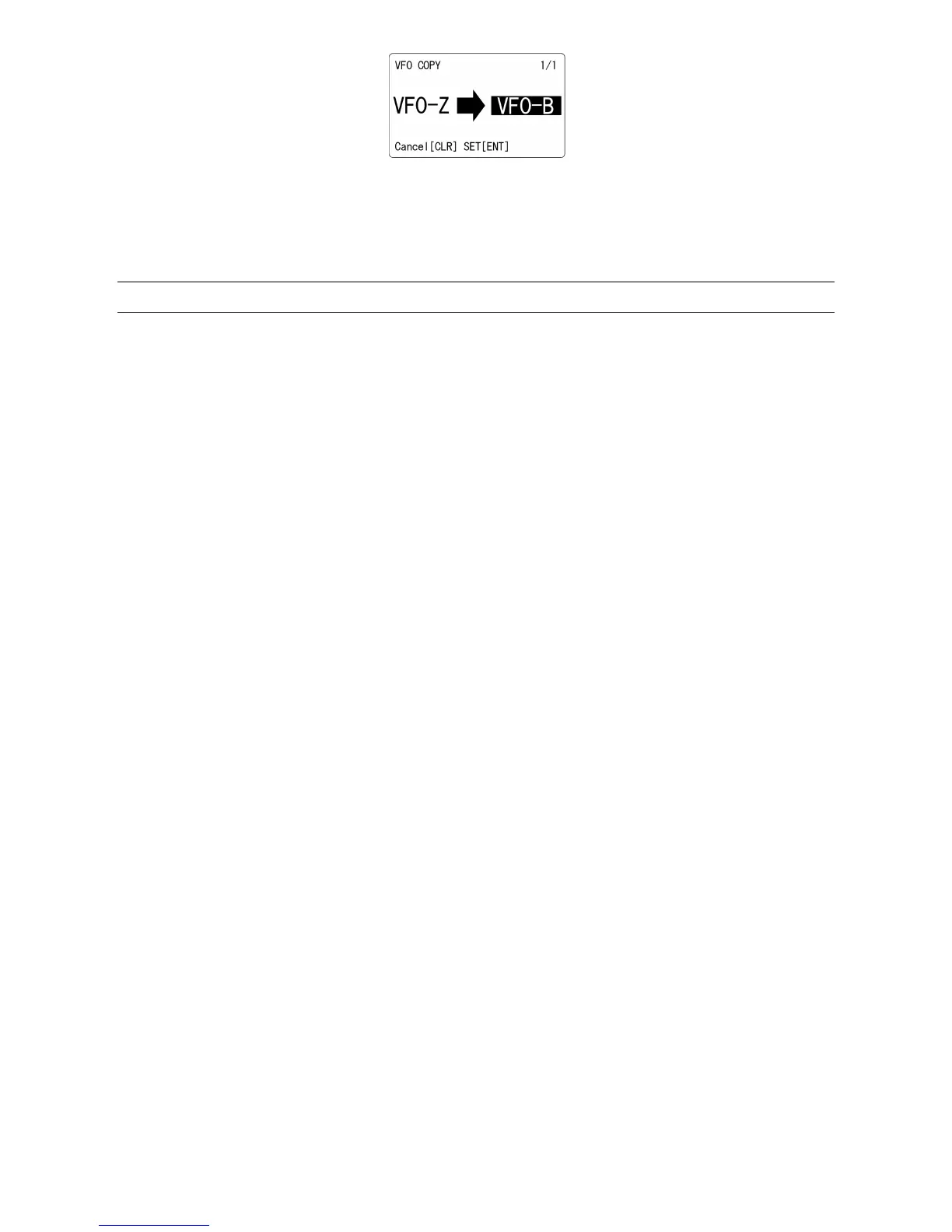
(While receiving frequency on VFO-Z, copy it to VFO-B)
To confirm selection, press the [ENT] key.
3-6 RECEIVE MODE
Due to the necessities of signal bandwidth, channel occupancy, and transmission efficiency, different
receive modes are used by various services. The tuning step and receive mode are allocated by
departments of governments following international discussions so they are not consistent throughout the
world. For this reason, it may be necessary to change receive mode to monitor various transmissions.
AM – Amplitude Modulation
Used by broadcast services throughout the world on long-, medium-, and shortwave frequencies,
AM is also used by VHF airband, and UHF military airband.
SAM – Synchronous AM
Helps to listen to SW (Shortwave) AM broadcast stations with fading signals. The selection
between SAH (higher side band) a SAL (lower side band) allows to choose the side band with the
least noise.
FM – There are two common types of FM (Frequency Modulation):
NFM – Narrow Band Frequency Modulation
Provides high quality communication for relatively short distance operations.
FM uses a greater frequency bandwidth than other modes.
NFM is the most common mode used above 30 MHz with the exception of the airbands. NFM is
widely used on the VHF bands: VHF marine band, 2m amateur band, 70 cm amateur band, PMR
(Private Mobile Radio) and utilities.
In the absence of a signal, the background white noise may appear quite loud. For easier listening,
the squelch control should be rotated clockwise until the background noise disappears; this should
be carried out while no signal is present. The point at which the background noise is cancelled is
known as the threshold point. Do not advance the squelch control more than necessary or the
receiver will appear to be desensitized and weaker signals will be missed.


 To Next Page