4
1 INTRODUCTION
1-1 INTRODUCTION
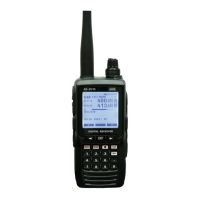
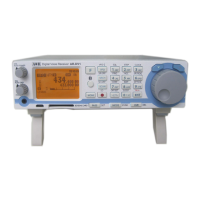
Thank you for purchasing the AR-DV1 SDR Digital Voice Receiver.
AOR is pleased to present you with the AR-DV1, the FIRST software defined digital voice receiver to
receive and decode virtually ALL popular digital modes such as MOTOTRBO™, DMR™, dPMR™, APCO
P25, NXDN™, Icom D-Star™, Digital CR, Yaesu, Kenwood ®, and Alinco EJ-47U as well as conventional
analog signals including AM, wide and narrow FM, upper and lower sideband and CW.
To ensure the best possible result, we strongly recommend that you read this manual and use it as a
reference to familiarize yourself with the receiver. Every effort has been made to make this manual correct
and up-to-date. Due to continuous improvements, we acknowledge that there may be some errors or
omission anomalies.
1-1-1 MAIN FEATURES
Wide frequency coverage: 100 kHz to 1.3 GHz (Cellular blocked for the US consumer version)
Direct conversion (100 kHz ~ 18 MHz)
PC controllable with Hyperterminal software by using our COMMAND LIST to be downloaded at
http://aorja.com/receivers/ar-dv1.html.
Multi-mode unit capable of receiving AM (Synchronous), USB, LSB, CW, NFM, P25 (APCO25),
NXDN™, D-STAR ™, ALINCO EJ-47U, YAESU, DIGITAL CR, dPMR™, DMR, MOTOTRBO™,
KENWOOD ®
SD card interface
Selectable IF filter bandwidths
CTCSS and DCS selectable squelch functions
Built-in voice-inversion descrambling (Not available for the US consumer version)
AGC
Auto-notch, noise reduction (NR)
USB interface
3 VFO’s, 2,000 alphanumeric memories
© This manual is protected by copyright AOR, LTD. 2015. No information contained in this manual may
be copied or transferred by any means without the prior written consent of AOR, LTD. AOR and the
AOR logo are trademarks of AOR, LTD. All other trademarks and names are acknowledged.
This device complies with part 15 of the FCC Rules. Operation is subject to the following two
conditions: (1) This device may not cause harmful interference, and (2) this device must accept any


 To Next Page