6
1-3 INCLUDED IN THE PACKAGE
The following items are provided in this package:
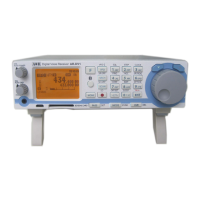
1 AR-DV1 receiver
1 AC power adapter
1 Operating Manual (this booklet)
1 Telescopic antenna
1 SDHC memory card
Terminology
Search & Scan
If this is your first time using a wide band receiver or you are not familiar with the terminology used, it is very
important to understand the difference between SEARCH and SCAN modes.
SEARCH: The AR-DV1 provides several operations where transmissions (active frequencies) may be
automatically located by sweeping the receiver over a wide frequency range, either from the currently
displayed frequency traveling upwards (or downwards) in a specified tuning increment (step) or by
sweeping over-and-over between two specified frequency limits. This process is known as
SEARCHING. As the name implies, this process can take a long time to find transmissions due to their
“often intermittent” and brief nature. For this reason, it is best to slice large frequency ranges into
smaller, more manageable pieces where they may be intensely monitored.
When examining large frequency segments, it is common to find that 90% of the frequencies are
inactive and only a small number of the remaining constitute what you really want. Searching still
remains the best way to initially locate active and interesting transmissions (in conjunction with a good
frequency listing and band plan).
SCAN: Once active transmissions have been identified (either by searching or by using a good
frequency guide), it is more efficient to store the data into memories which can be rapidly and
automatically monitored in succession, stopping when activity is encountered. This is a much more
efficient means of monitoring the most wanted frequencies as you have targeted 100% of what you
most want to hear. By contrast, searching is very inefficient for day-to-day monitoring.
Note: For the search & scan functions to operate properly, it is very important to advance the
squelch to cancel background noise. This is because the AR-DV1 believes that it has found an
active frequency when the squelch opens and the “BUSY” indicator lights up. Advance the
squelch control clockwise until the background noise is just cancelled; this is known as the
“threshold” position. If the squelch control is advanced too far, weaker signals may be
missed.
Receive Mode / Additional Features
FM
Built-in DCS (Digital Coded Squelch)


 To Next Page