Page 29 of 78
4.3 SFP and SFP+ Transceiver Modules
SFP (small form-factor pluggable) transceivers are compact, hot-pluggable devices that act as an
interface between networking equipment (network switches, routers, network cards, etc.) and
interconnecting cabling (copper or fiber).
While SFP and SFP + transceivers are both similar in size and appearance, the main difference is that
SFP+ can be used in 10 Gigabit Ethernet applications, while SFP is for 100/1000BASE applications.
SFP+ can also operate at 100/1000BASE. SFP complies with standards of IEEE 802.3 and SFF-8472,
while SFP+ is based on SFF-8431.
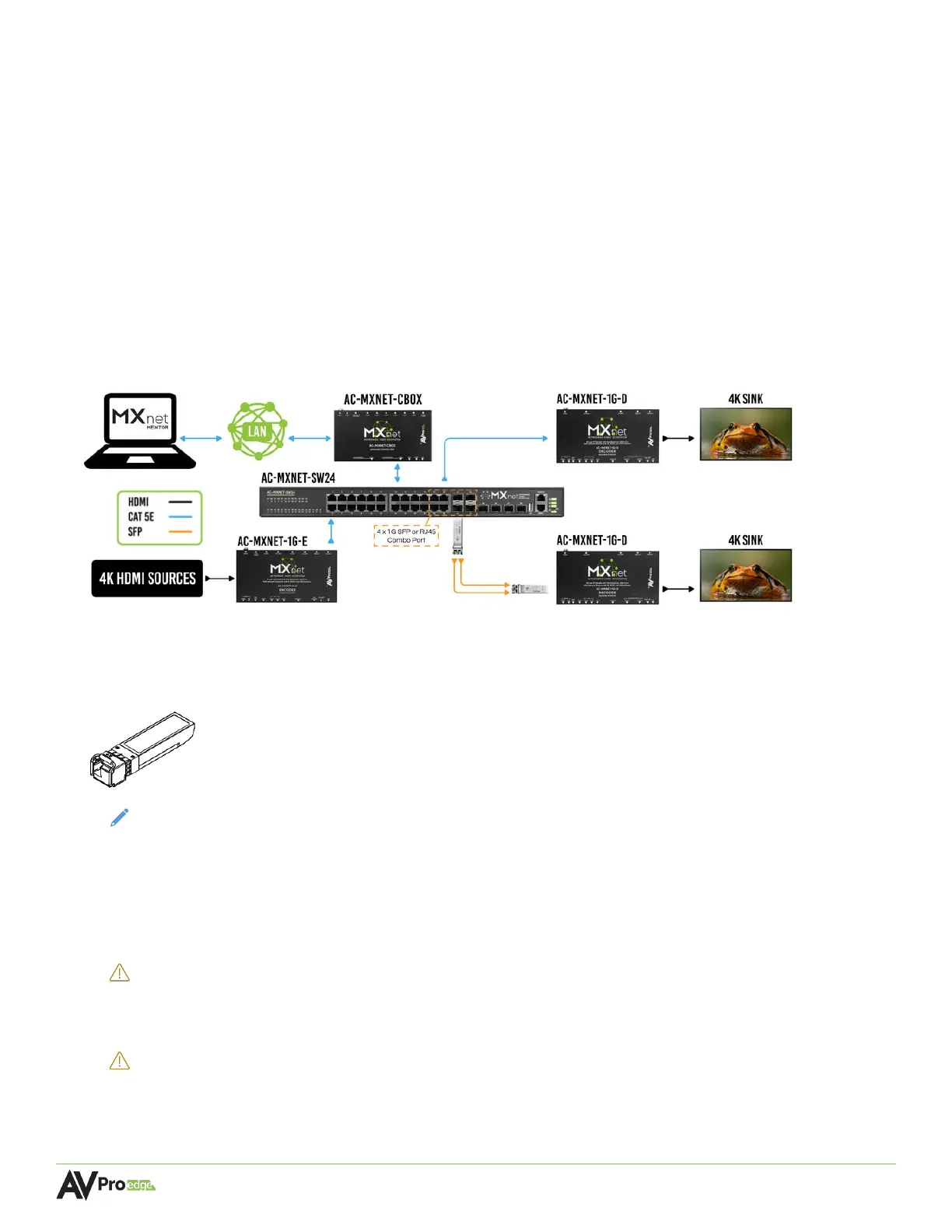
MXNet can send many gigabytes of data per second with either copper or fiber connections. RJ-45
copper connections are cost-effective, but when security and stability are critical, the SFP module is
recommended.
The module is inserted into the SFP slot on the MXNet devices and is used for network connection
and AV transmission. SFP modules are not supplied with the devices.
NOTE: The MXNet network switches are compatible with most SFP and SFP+ transceivers on
the US market. Functionality can be guaranteed with manufacturers 10Gtek® and
HiFiber© as these have been tested and verified by AVPro Edge. The SFP+ ports can
also operate at 1GbE speed, meaning that the AC-MXNET-SW48 can operate as a 52
port 1GbE switch, allowing for connections of up to 52 MXNet endpoints (CBOX,
encoders, and decoders).
IMPORTANT: The AC-MXNET-SW10 network switch has two SFP ports, while the AC-MXNET-SW48
has four SFP+ ports. The AC-MXNET-SW24 has both four SFP ports and four SFP+
ports.
IMPORTANT: Only one of the network ports is available at a time on the MXNet network switches,
either the SFP or RJ-45. When an SFP is connected to a network, the RJ-45 port is
disabled.



 To Next Page