Arena Service Manual
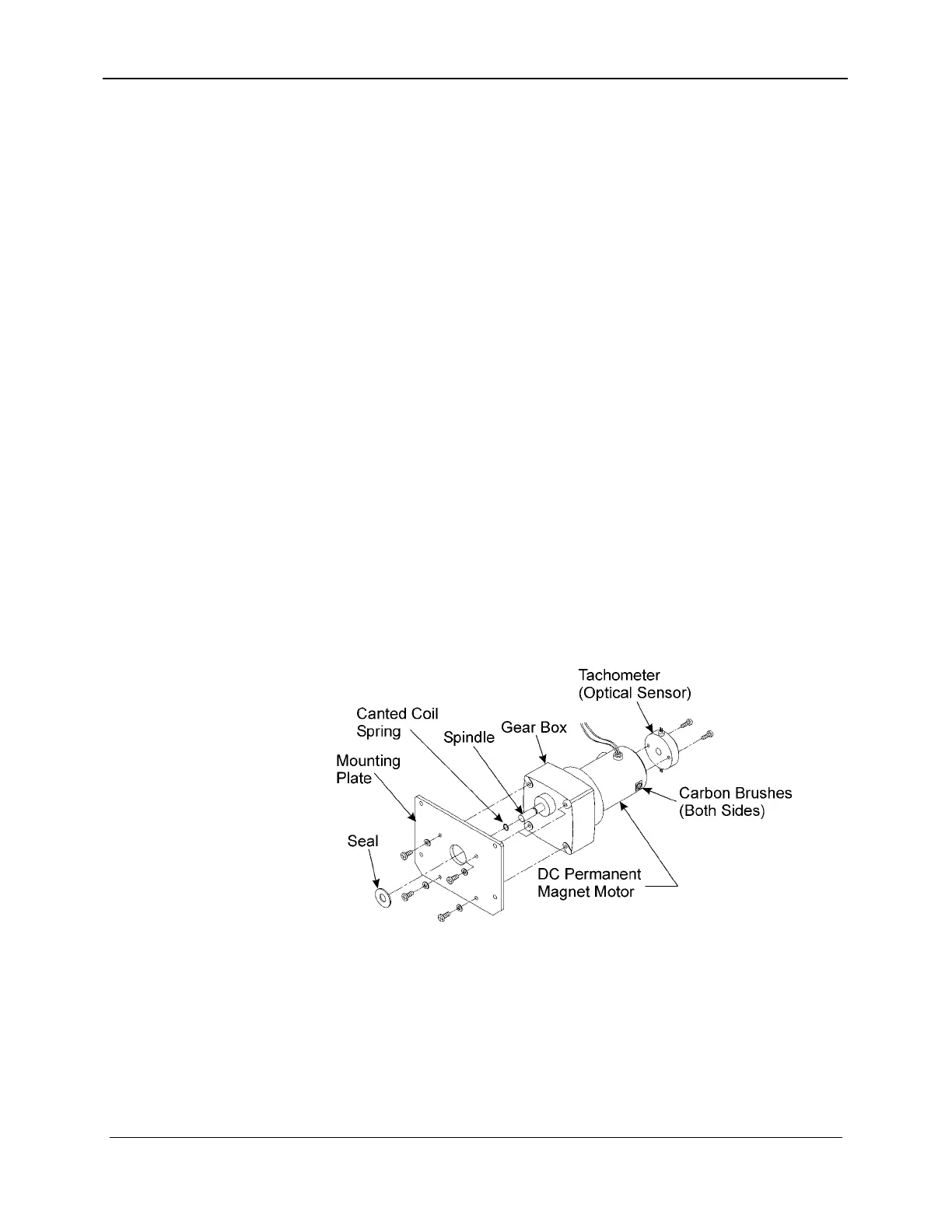
Mounting Plate. Helps to correctly attach and position the BP
assembly in the Instrument.
Gear Box with Spindle. Transmits the rotary motion of the DC
Motor to the BP Rotor (see Figure 10-1) providing the appropriate
change in speed and torque. You can gain speed or torque at the
expense of the other.
Canted Coil Spring. Mounted on the Spindle, it holds the Rotor
assembly in place.
DC Permanent Magnet (Brush-type) Motor. This type of motor
uses a permanent magnet to generate the magnetic field in which
the armature rotates. Torque is an inversely proportional linear
function of speed. At the same time, speed is proportional to
voltage and torque is proportional to current; therefore, any
increase in the BP torque will be accompanied by a corresponding
decrease in speed or vice versa as long as the total BP power
remains the same.
This is a reliable, low-cost motor that can produce high starting
torque and can be decelerated rapidly. In particular, the ability to
quickly decelerate the motor is important because in case of an
extracorporeal alarm, the BP must immediately stop rotating to
isolate the patient from the Instrument.
Tachometer (Optical Sensor). Measures the speed of the motor.
See Section 10.5 for more information.
Figure 10-1. Blood Pump Assembly
The external elements are the doors and reed switches (see Section
10.3), and the Rotor assembly (see Section 10.4).
The BP can use different sizes of blood tubing. The size must be
selected and the rotor occlusion calibrated by a certified
technician. Refer to Sections 17.3.1.3 for tubing size selection,
and 18.6.1 and 18.6.2 for calibration.
10-4 157-1278-917 Rev A
April 2004






 To Next Page