151
20 08 CONTESSA
PROPANE SYSTEMS — 7
PROPANE REGULATOR
Propane is compressed into liquid form in the
tank. Only the vapor is used during combustion
by an appliance. As vapor is removed from
the tank, the remaining liquid will vaporize
to maintain pressure that is removed during
consumption. This process will continue until
there is no liquid remaining in the tank.
Temperature affects the vaporizing action of
the liquid. If temperature of the liquid is - 44º
F, the liquid remains stable with tank pressure,
about 0 psi. If liquid temperature is 100º F, the
liquid quickly vaporizes with tank pressure, about
200 psi. Vapor pressure must remain relatively
consistent, regardless of temperature, for the
appliance heat output to remain stable. Vapor
pressure regulation is performed by the regulator.
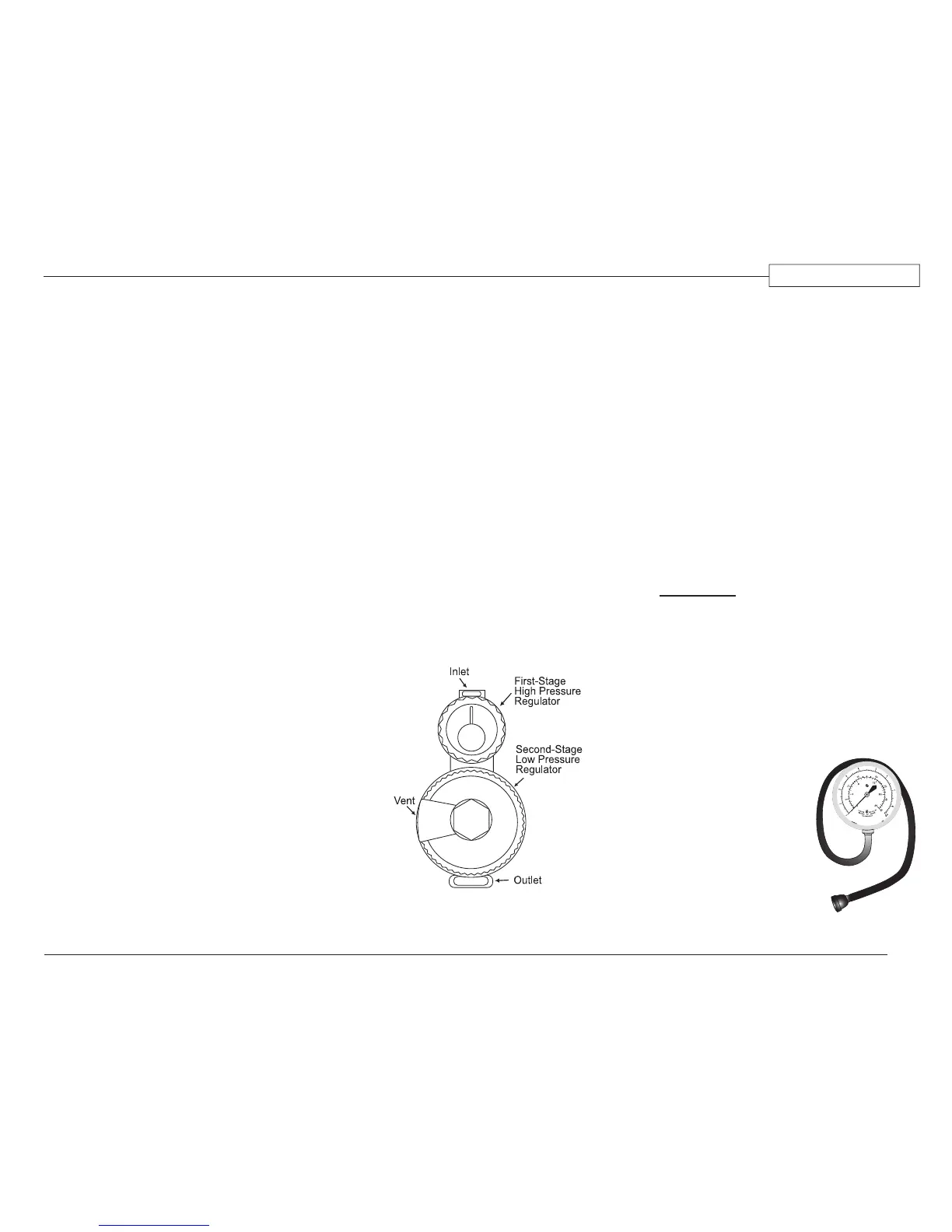
The two-stage regulator reduces vapor
pressure so that it is safe for use. The rst stage
of the regulator reduces tank pressure to a range
of 10 to 13 psig (pounds per square inch gauge).
The second stage further reduces pressure to
a working pressure of 0.4 psig (11 Inches of
Water Column or about 6¼ ounces psi.). A vent
is installed to allow the internal diaphragm to
move with atmospheric pressure change. It is
important to keep the vent clean and clear of
obstruction or corrosion. If the vent becomes
clogged, pressure from the propane tank may
cause erratic pressure regulation. If there is any
corrosion, contact a qualied propane service
technician. The regulator is mounted so that
the vent faces downward. If the vent becomes
clogged, clean it with a toothbrush.
Under normal atmospheric conditions a
propane regulator will not freeze, nor will
propane. Vapor passing through the regulator
will expand and cool, condensing moisture in
the gas. The moisture will freeze, build up and
block the vent. The possibility of freeze up is
greatly reduced with the two-stage regulator.
To Prevent Freeze Up:
Ensure the propane tank is totally free of
moisture prior to lling.
Ensure the tank is not overlled.
Keep the valve closed when the tank
is empty.
If A Freeze Up Occurs:
Have a propane distributor purge the
tank.
Have the propane distributor inject
methyl alcohol in the tank.
Damage to the regulator can occur when the
tank is overlled. The regulator is designed to
work with vapor only. This is why the tank is
lled to only 80% of its liquid capacity. The
other 20% allows for vaporization of the liquid.
The primary vapor valve is located in the vapor
section of the tank. In an overlled tank, liqueed
petroleum can ll the regulator. Vaporizing liquid
can freeze the diaphragm. High tank pressure on
a frozen diaphragm can cause a rupture and result
in erratic pressure regulation. This is why it is
important to have the propane pressure checked
for proper pressure and accurate regulation
during appliance operation. Erratic pressure
regulation dramatically affects refrigerator
operation on propane.
WARNING:
DO NOT attempt to adjust the
regulator. Adjustments require special
equipment. Failure to follow these
instructions may result in a fire or
explosion, and can cause severe personal
injury or death. DO NOT operate
propane appliances until the propane
pressure is checked and a leak down test
is performed.
Manometers:
The manometer is the best
way to accurately determine
propane pressure. There
are two different styles of
manometers: Gauge and
U-tube.
050251a
050260
Manometer
Gauge



 To Next Page