229
20 08 CONTESSA
CHASSIS INFORMATION — 10
Coolant System - Thawing:
If the coolant system becomes frozen,
the motorhome must be towed. Place the
motorhome in a warm area until completely
thawed. If the engine is operated when the
cooling system is frozen, the engine may
overheat due to insufcient coolant circulation.
Once thawed, check the engine, radiator and
related components for damage caused by
expansion of frozen coolant.
Coolant Hoses:
Inspect coolant hoses and connections when
checking engine or transmission uids. Look for
any signs of chafng at hose restraints or sharp
edges. Indications that hoses have reached the
end of service life include cracking or swelling
around clamps and connections. Oil leaks can
also deteriorate hoses.
Overheating can be caused by a collapsed
hose. Old hoses can also deteriorate on the
inside causing partial clogs reducing cooling
efciency. Replace any hose found to be
cracked, swollen or damaged. Periodically
check hose clamp torque.
INSPECT:
Every 12 months, inspect all hoses,
clamps, and fittings for leaks due to
cracking, softness and loose clamps/
fittings. Look for signs of fluid leaks,
damaged end fittings or ballooning;
chafed, kinked, or crushed hoses; and
loose clamps and fittings. Correct any
deficiencies found.
Radiator/Charge Air Cooler
The diesel engine uses compression to ignite the
fuel/air charge. To increase compression inside the
combustion chamber (resulting in increased power
output) a turbocharger is added to the engine. The
turbocharger is a paired housing assembly with
impellers inside each housing connected by a
common shaft. One impeller is propelled by the
engine exhaust, which drives the other impeller.
The function of the other impeller is to increase
compression inside the combustion chamber by
forcing air into the intake manifold.
This process works well, however, the
intake air to the engine is heated two different
ways: through convection by the exhaust
gases driving the turbocharger and when air
is compressed. This negative effect inside the
combustion chamber results in lost power
potential. Therefore, a Charge Air Cooler
(CAC) is installed to cool the intake air before
it enters the engine. The CAC performs the
same function as a radiator, cooling air instead
of liquid. Ambient air passing through the CAC
will cool the engine intake air charge.
After leaving the turbocharger, intake air
is compressed and heated to approximately
300º to 375º F., depending on the engine load
and throttle position. Before air enters the
intake manifold, the CAC cools the intake
air temperature to the engine manufacturer
specications. Lowered intake air temperatures
reduce exhaust emissions, improve fuel
economy and increase horsepower. The CAC
will continually expand and contract up to ¼" as
throttle increases and decreases.
Cleaning and Maintenance:
Inspect the charge air cooler every
week and remove dirt and debris that
may block the ns. If the motorhome
develops an oil leak, there is a possibility
that the oil will coat the ns of the CAC.
Dust will adhere to the oil lm, clog the
ns and reduce cooling efciency. When
the oil leak is repaired, the CAC must be
thoroughly cleaned.
020165h
090510
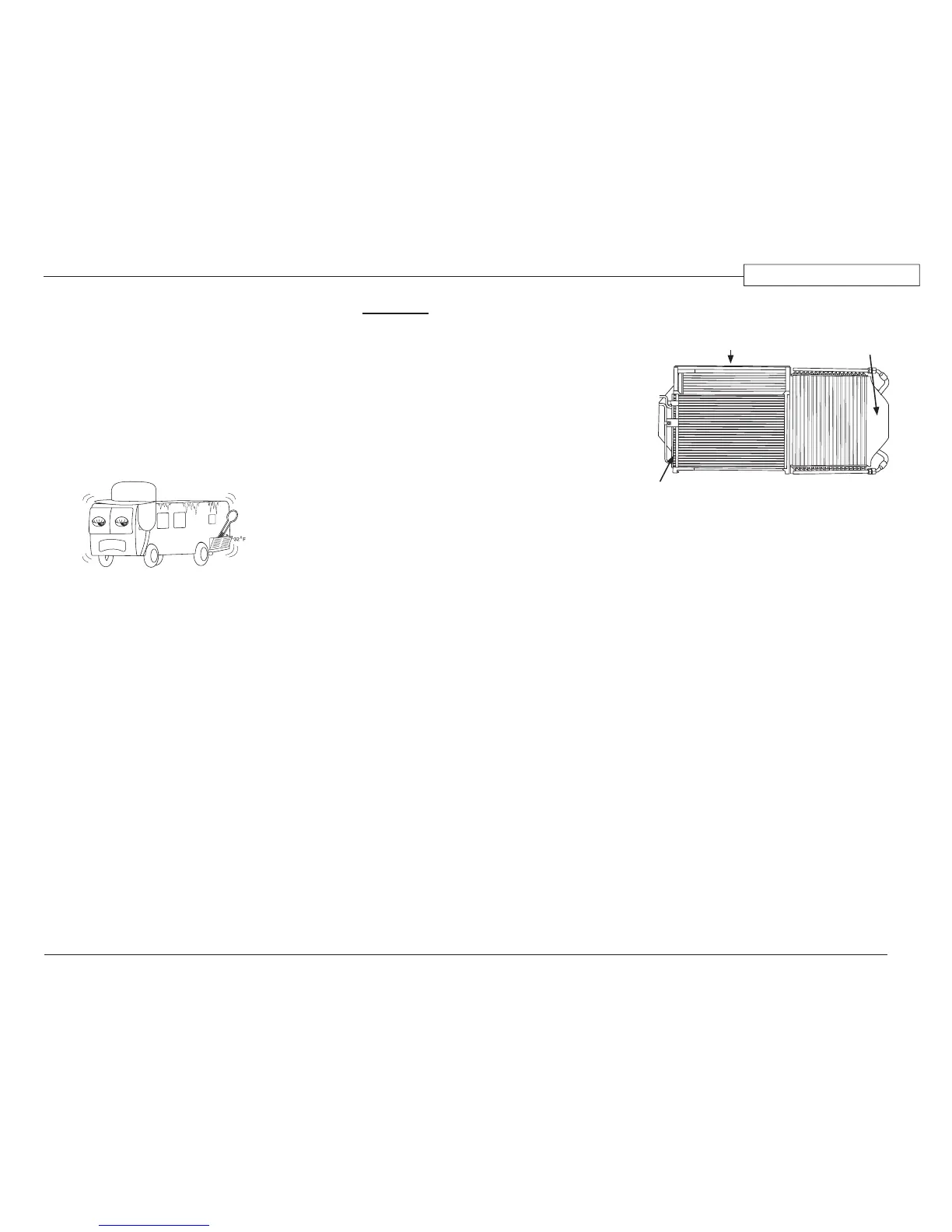
Charge Air Cooler
A/C Condenser
Hydraulic Cooler
Radiator located behind Charge Air Cooler


 To Next Page