CHASSIS INFORMATION — 10
198
20 08 CONTESSA
CHASSIS - INTRODUCTION
This section contains information and
instructions regarding various components of
the motorhome chassis. Follow the guidelines
and procedures to help understand and operate
the motorhome. Complete instructions for the
engine and transmission are located in their
respective operator’s manual included in the
Owner’s Information File Box.
WARNING:
When welding is involved for
motorhome repair or modification,
only qualified, experienced technicians
should weld on the chassis. Improper
welding procedures and materials
may weaken the assembly or result in
damage that is not obvious and may not
cause an immediate problem or failure.
Unauthorized modifications or repairs
to the chassis could result in a forfeiture
of warranty coverage.
DANGER:
Due to the sensitive nature of the
electronics on the chassis, the following
precautions are required to protect
electrical components in the motorhome
chassis:
1. Disconnect the (+) positive and (-)
negative battery connection.
2. Cover electronic control components
and wiring to protect from hot
sparks.
3. Disconnect the terminal plugs from
the engine Electronic Control Unit,
located on the curbside side of the
engine block.
4. Disconnect all the plugs from the
transmission Electronic Control Unit,
located in the front electrical bay.
5. Disconnect the wiring from the
alternator.
6. DO NOT connect welding cables to
electronic control components.
7. Attach the welding ground cable no
more than two feet from the part to
be welded.
The Roadmaster chassis design provides
exceptional balance, handling and braking
characteristics. The Roadmaster chassis is an engine
and frame unit featuring an all steel frame design,
providing structural integrity and uniform stress
distribution. The air suspension system incorporated
in the Roadmaster chassis uses eight air bags and
shock absorbers. The tag axle (42' models only) uses
two in-board mounted air bags. This design provides
the smoothest ride, best handling and trouble free
service while delivering excellent drivability. The
Roadmaster chassis design offers unsurpassed ease
of maintenance and service. The chassis also has a
three-point hydraulic leveling system or an optional
air leveling system.
The Roadmaster’s raised-rail chassis with air
suspension consists of front and drive axles with
trailing links. The tag axle (42' models only) uses
leading arms. A panhard bar on each axle controls
side motion. The axles mount to the trailing links
that are connected to the chassis. The suspension
control arms attach to the frame through
bushings, which require no lubrication. Unlike
suspension that uses springs, the air suspension
system automatically maintains the same attitude
and ride height throughout the entire load range.
The raised rail design of the main chassis offers
increased bay storage space.
The towing receiver is rated at 10,000 lbs.
towing weight and 1,000 lbs. tongue weight.
NOTE:
Only 42' models are equipped with a tag
axle.
AIR SUPPLY SYSTEM
The air compressing system on the motorhome
includes a compressor, governor, dryer, front
tank and rear tank. The compressed air system
operates several items, including brakes,
suspension, air horns, air gauge and the stepwell
cover. The air system is charged by a gear
driven air compressor mounted on the engine.
As engine speed increases, compressed air
output increases. When the air is compressed,
heat is generated. Heat dissipates as the air
is discharged from the compressor. Moisture
condenses in the compressed air as it cools and
enters the air dryer to be ltered. The ltered
air charges the front air tank, which is divided
into a wet and dry side. The compressed air
enters the wet side before entering the dry side.
A discharge line from the dry side of the front
air tank charges the rear air tank. Discharge lines
use in-line check valves to prevent a back ow
of compressed air.
100168b
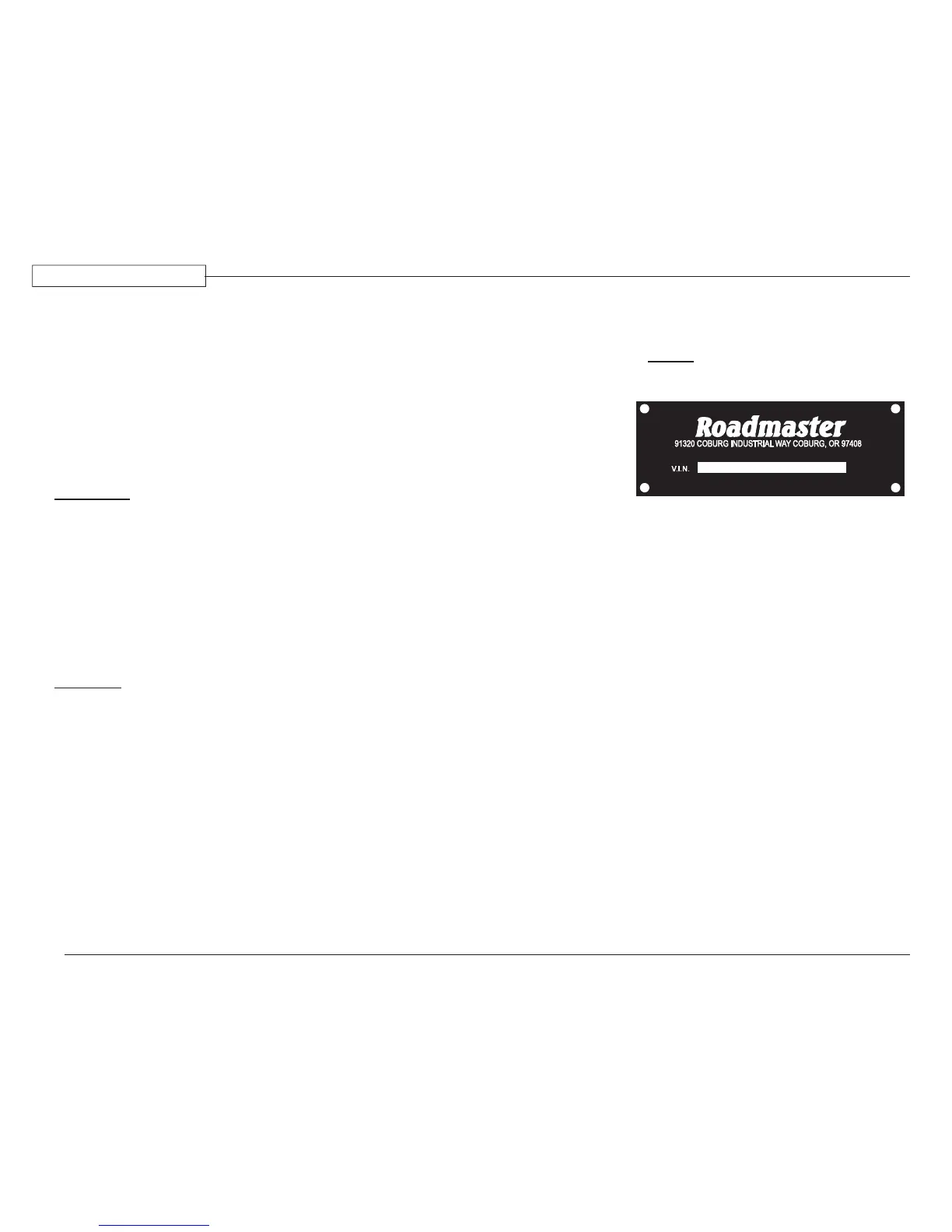
Tag located on curbside frame behind front wheel
and in generator compartment.


 To Next Page