CHASSIS INFORMATION — 10
236
20 08 CONTESSA
Fuel Lines & Hoses
Make a visual check for fuel leaks at all
engine-mounted fuel lines, connections and at
the fuel tank pick-up and return lines. Leaks
in this area may best be detected by checking
for accumulation of fuel under the tank.
Engine performance and auxiliary equipment
is dependent upon the ability of exible hoses
to transfer lubricating oil, air, coolant and
fuel. Maintenance of hoses is an important
step in ensuring efcient, economical and safe
operation of the engine and related equipment.
INSPECTION:
Check hoses for leaks each day as part
of the pre-start inspection. Check all
fittings, clamps and ties. Ensure the
hoses are not touching shafts, couplings
or heated surfaces, including exhaust
manifolds, sharp edges or other obvious
hazardous areas. Vibration from the
engine and road can move or fatigue
clamps and ties. To ensure continued
proper support, inspect fasteners
frequently and tighten or replace them
as necessary.
Fuel Filters
The engine has a primary and secondary fuel
lter. The primary lter, located in the engine
compartment, is a fuel/water separator equipped
with a see-through collection bowl. Since water
is heavier than fuel, water can be observed in
the collection bowl. Check the primary fuel
lter daily or before each trip. The secondary
lter is mounted on the engine.
NOTE:
It is recommended to wear gloves and
old clothing when working with diesel
fuel. Avoid getting fuel in the interior of
the motorhome.
Filter Maintenance Intervals:
Drain the primary fuel lter daily
before travel.
Change the primary fuel lter every
six months or every 15,000 miles or at
the rst indication of power loss.
Refer to the engine OEM manual for
service intervals of the secondary fuel
lter.
Water in Fuel Light:
If the WATER IN FUEL light illuminates
on the dash, the primary lter has detected
water in the fuel. DO NOT continue engine
operation. Fuel contaminated with water can
damage fuel injectors. Water is heavier than
fuel and will collect in the primary lter.
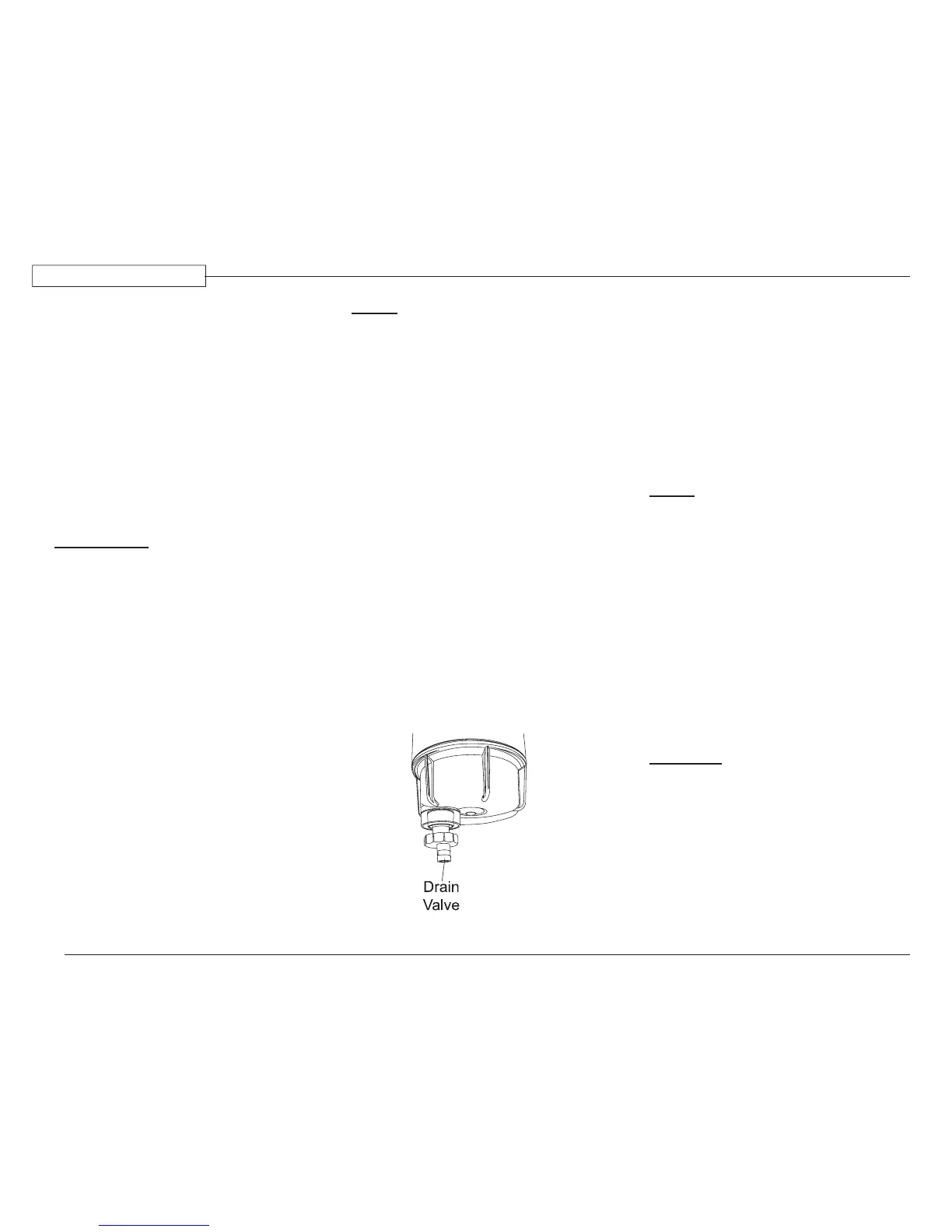
Drain the primary lter by opening the valve
on the bottom of the lter bowl.
To Drain the Filter:
Shut off the engine.
Open the drain valve, by hand,
counterclockwise approximately 1½ to 2
turns until draining occurs. Drain water/
fuel into a container and dispose of in
accordance with local environmental
regulations.
Close the drain valve by turning
clockwise when clear fuel is visible.
NOTE:
Water and sediment from the filter can
contain petroleum products. Consult
the local environmental agency for
recommended disposal guidelines.
HYDRAULIC SYSTEM
The motorhome uses an engine driven
hydraulic pump to operate both the power
steering and engine hydraulic cooling fan
systems, which share one common reservoir.
The hydraulic uid used is Texaco Rando
HD46 which has a wide ambient temperature
operating range.
CAUTION:
If ambient temperatures approach 0º F.,
Pennzoil Arctic Blue hydraulic fluid, or
equivalent hydraulic fluid, should be
used. Using incorrect hydraulic system
fluid weights in cold temperatures will
raise the hydraulic system operating
pressure and may damage the hydraulic
cooler.
090481e


 To Next Page