235
20 08 CONTESSA
CHASSIS INFORMATION — 10
NOTE:
Due to the precise tolerances of diesel
injection systems, it is extremely
important that fuel be kept clean and
free of dirt or water. Dirt or water in the
system can cause severe damage to both
the fuel pump and the fuel injectors.
Fuel additives for lubricity are not
recommended. There are numerous
diesel fuel additives to help remove
moisture from fuel, prevent microbe
growth and to prevent gelling during
cold weather. Before adding any type
of fuel additive or extender, consult the
Manufacturer’s Owner’s Manual.
Fuel Tank
Pick-up and return lines are placed at opposite
ends of the tank to inhibit fuel aeration. The
engine pickup tube is cut at a 45° angle to allow
optimum ow to the engine. The generator and
Aqua-Hot intake tubes are set to approximately
¼ of a tank. This will prevent depleting the fuel
supply while dry camping.
NOTE:
Fill the fuel tank during storage
to reduce the amount of potential
condensation. After storage, check
the vent tube for blockage. It is not
uncommon for insects to plug the vent
tube. If pressure or vacuum exists when
the fuel cap is removed, the vent tube
may be blocked. The end of the vent
tube is located on the curbside of the
fuel tank, near the bottom.
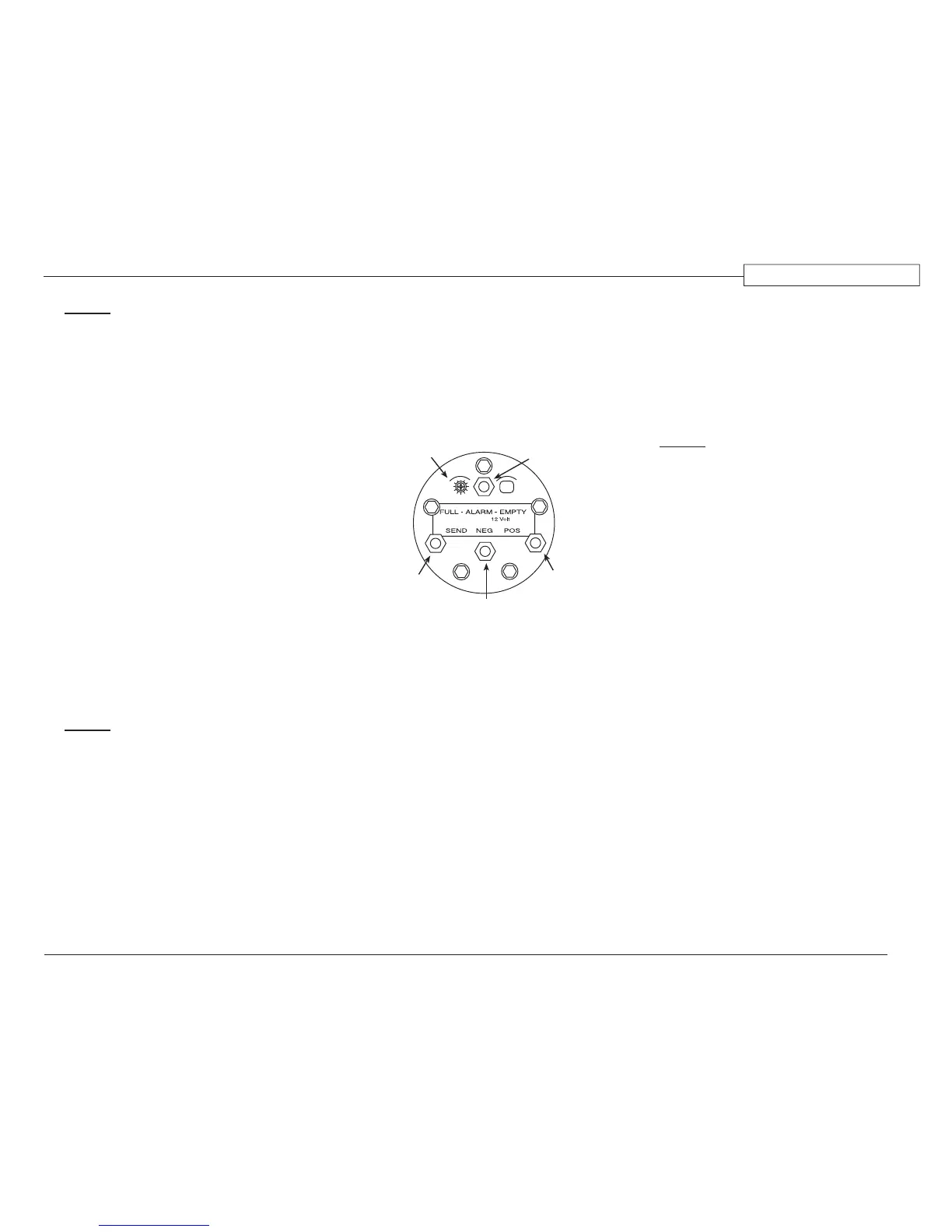
Fuel Sender
The Centroid fuel sender has no moving parts
and works by measuring between inner and
outer tubes in the tank. Electronics in the head
of the sender convert the capacitance to current
to drive the fuel gauge.
Connections:
Positive (POS) and Negative (NEG) -
Battery voltage to run the electronics in
the sender head.
Send - Connects to the fuel gauge on the
dash.
Adjustments:
Empty - Adjusts for length of sender.
It is set at the factory, covered with a
sealant and should not be changed.
Full - Used to correct for slight
differences between fuel meters. This
is factory calibrated and does not need
adjustment.
The correct adjustment technique, with a full
tank of fuel, is to start with the full adjustment
screw turned completely clockwise. This should
cause the reading to be above full. Rotate
counterclockwise slowly until the full mark on
the gauge is reached. The intent is to always
adjust downscale rather than upscale.
NOTE:
The adjustment must be made within
30 seconds of turning on power. If the
adjustment is not finished in time,
turn the power off and back on to
get another 30 seconds of adjustment
time. The sensor responds too slowly
after 30 seconds (damped output) to
allow adjustment.
Troubleshooting:
Electronic Output: The sender has a
transistorized output to prevent an
ohmmeter from getting a correct reading of
output resistance.
Fuel Only: The sender will not work
correctly in conducting uids such as water
(it will read empty all the time in water).
If there is a constant empty reading, there
may be water in the bottom of the fuel tank.
Contact Centroid: Many of the returned
Centroid units function properly on the
bench. If there are incorrect readings,
contact Centroid (telephone: 800-423-3574,
or preferably, fax: 386-423-3709) with
the symptoms. A short, “ll in the blanks”
troubleshooting test is provided to test the
sender. It is easier to nd the problem that
way than after the sender has been removed
from the system, since the problem is not
necessarily with the sender.
090318
RED:
To Gauge
WHITE:
Ground
YELLOW:
Ignition
Full
Adjust
BLUE:
Low Fuel
Indicator
Centroid Fuel Sender


 To Next Page