ELECTRICAL SYSTEMS - HOUSE — 8
166
20 08 CONTESSA
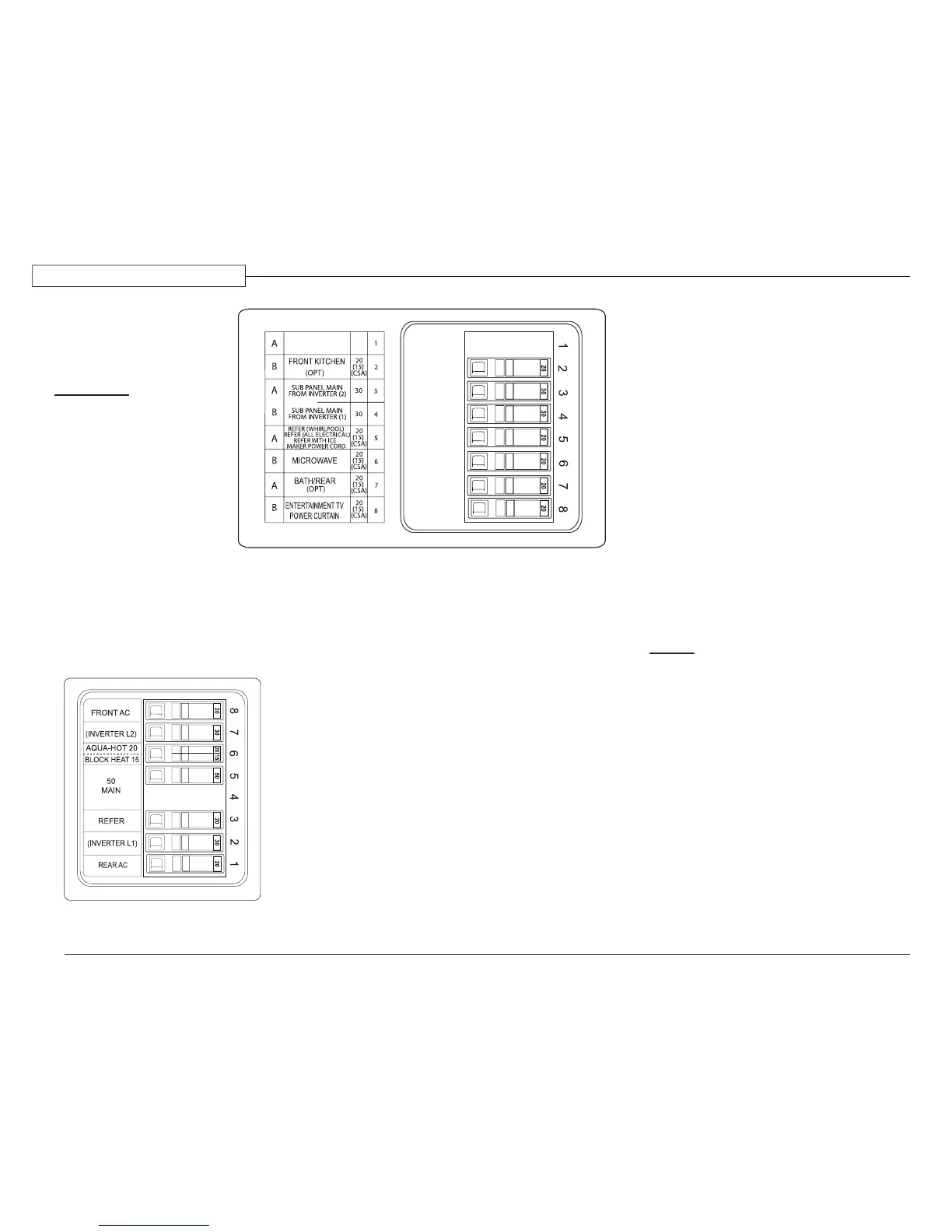
The panel label describes the
breaker layout and the item,
outlet or appliance to which
they pertain.
WARNING
The 120/240 Volt AC
panel contains high
voltage which can
cause serious injury or
death. Before beginning
any work or testing
procedures involving the
electric panels or any of
the branch circuits, be
sure the motorhome is
unplugged from shore
power, the generator is not
running and the inverter
is in the off position.
Certain testing procedures may require
the AC power to be on. Only qualified
personnel with electrical backgrounds
should attempt any testing procedures.
Circuit Breaker
The internal conguration of the circuit
breaker is designed to trip when excess
current causes the breaker to heat up. The trip
action of the circuit breaker can occur within
milliseconds. Breakers are designed to operate
at a continuous load of 80% of the breaker’s
rated capacity.
For example: A breaker with a 20 Amp
rating will operate a continuous 16 Amp load.
This design leaves a small amount of working
capacity within the breaker. When an inductive
load is applied, such as when an electric motor
turns on, the motor starts to spin and current
consumption may momentarily exceed the
rated capacity of the breaker. As the electric
motor comes up to operating speed, the electric
motor’s current consumption will decrease. The
AC current load then falls back into the breaker’s
rated 80% set point. This electric principle should
be kept in mind when using anything other than
50 Amp shore service and using appliances with
electric motors, such as air conditioners. When
using outlets, care should be considered when
applying loads such as electric motors, heaters,
coffee makers, toasters, hair dryers or other large
current consuming loads. The current rating
is usually stated on most electrical items. The
current rating will either be rated in amps or
watts. Current ratings stated on electrical items
will change slightly with voltage uctuations. As
voltage increases, current consumption decreases.
As voltage decreases, current consumption
increases. This may explain why in some
instances items operated at borderline voltage to
current tolerances may seem ne in one location
but problematic in another.
NOTE:
To calculate watts to amps simply divide
the watt figure by the voltage of which
the item operates from. For example: The
electrical item is rated at 1370 watts. Divide
that by the operating voltage of 115 Volts
AC which equals 11.913 Amps. Use this
formula to calculate the amount of load
and compare to the available power supply.
GFCI BREAKERS & OUTLETS
A Ground Fault Circuit Interrupter
(GFCI) can be found in two different types
of applications. One type is incorporated in a
breaker used in 120 Volt AC breaker panels; the
other is incorporated in an outlet.
Typical Sub-panel
060143g
Typical Main Panel
060142e



 To Next Page