181
20 08 CONTESSA
ELECTRICAL SYSTEMS - CHASSIS — 9
engine the opportunity to start and warm up
before a heavy load, such as discharged house
batteries, are placed on it. If chassis battery
voltage should fall below 12 Volts DC for more
than four seconds, the relay will drop out so
full alternator output to the chassis battery is
available as needed to keep the engine running.
This even may happen when the alternator is
unable to supply sufcient current to all of the
loads and charge the house batteries at the same
time. When the chassis voltage again reaches
above 13.3 Volts DC, the relay will close in four
seconds and send charge to the house batteries.
A resultant ickering of lights may signify
alternator overload.
Inverter Charging the Batteries:
When the motorhome is plugged into shore
power (or the generator is running) and the
ignition is off, the unit senses the voltage on the
house batteries. When this voltage goes above
13.3 Volts DC for approximately 12 seconds,
as happens when the inverter is not heavily
loaded, it will close the isolator relay to provide
charging current to the chassis batteries. If the
voltage should fall below 12.8 Volts DC for
more than four seconds, the relay will drop out
to prevent the house loads from discharging the
chassis battery. This might happen when a heavy
demand is placed on the inverter. When the
house battery voltage again reaches above 13.3
Volts DC, the relay will close in four seconds
and send charge to the chassis batteries.
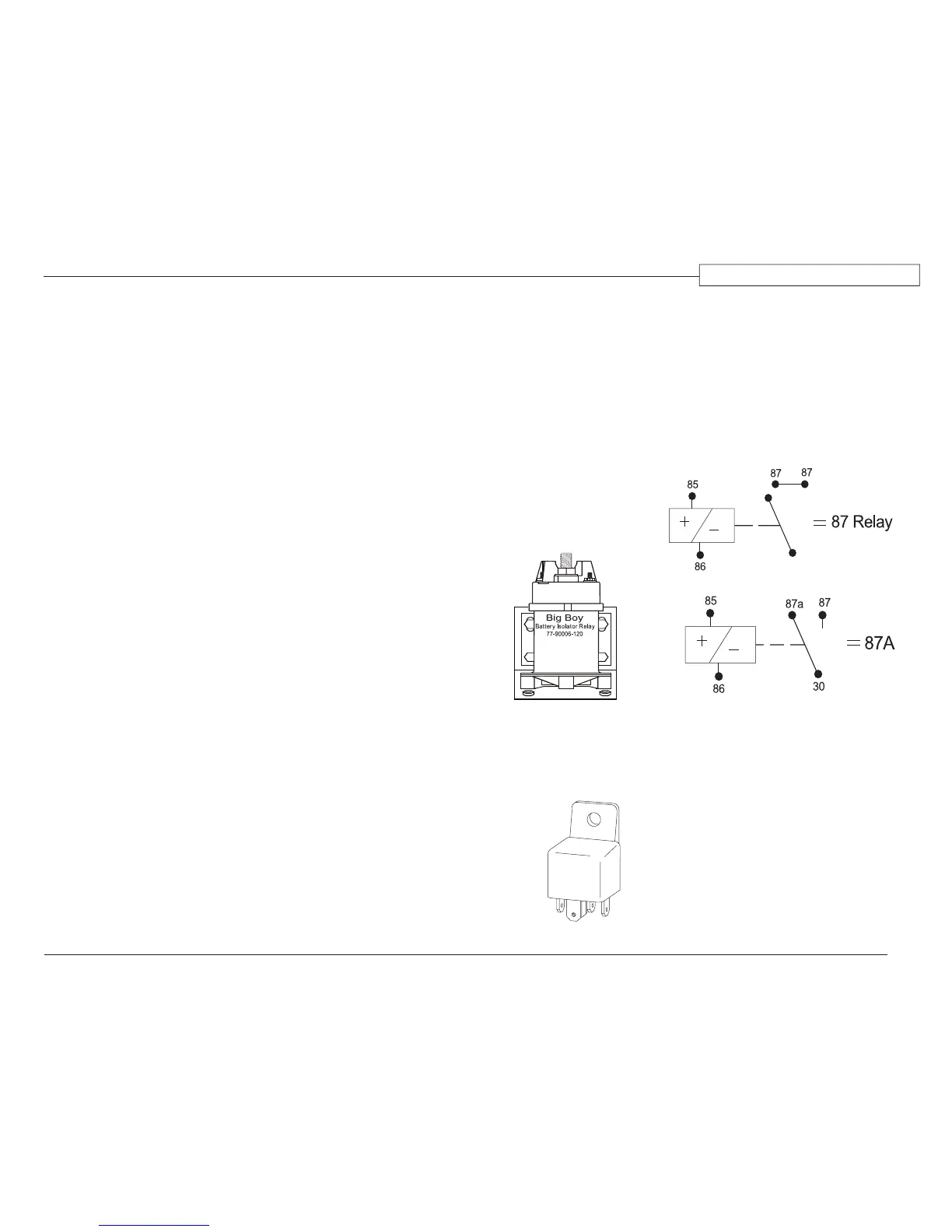
Isolator Relay
The Isolator Relay provides a simple means
of isolating the two battery systems, house and
chassis, and connecting the batteries together
when the engine is running.
A momentary dash-mounted switch is added
to provide a boost for the engine batteries from
the domestic batteries.
When using the battery boost switch, the relay
may have to deliver the full starting current to
the engine batteries. The relay contacts must
close and provide low resistance without the
harmful effects of arcing.
To be sure relays can
perform under harsh
conditions, the contacts
are protected with a
unique antioxidant
coating. The relay is
of heavy construction
and can easily deliver
the needed current. In a
battery charging situation,
both batteries will charge
at equal voltage.
Relays
The motorhome uses various
relays to operate electrical
equipment such as lights and
motors. If a relay needs to be
replaced, carefully record the
location of each wire and all
markings or labels.
Relays can look the same in appearance, but
differ in function. Note that on the side of the
relay is a schematic drawing identifying if the
relay is 87 or 87a relay. These current ratings
differ, and if mixed, will create problems.
Ensure the replacement relay is of the current
rating to assure proper operation.
Another indicator to the type of relay is the post
or legs. Turn the relay over and look at the post.
Note differences between numbered posts:
1. The 30 post is the incoming fuse
and/or breaker power. Some relay
applications supply power to the 30
post. Some use it for ground. The 30
post can be used many different ways.
2. The 85 post is one side of the coil,
tripped different ways.
3. The 86 post is the opposite side of the
coil, tripped different ways.
080406


 To Next Page