CHASSIS INFORMATION — 10
228
20 08 CONTESSA
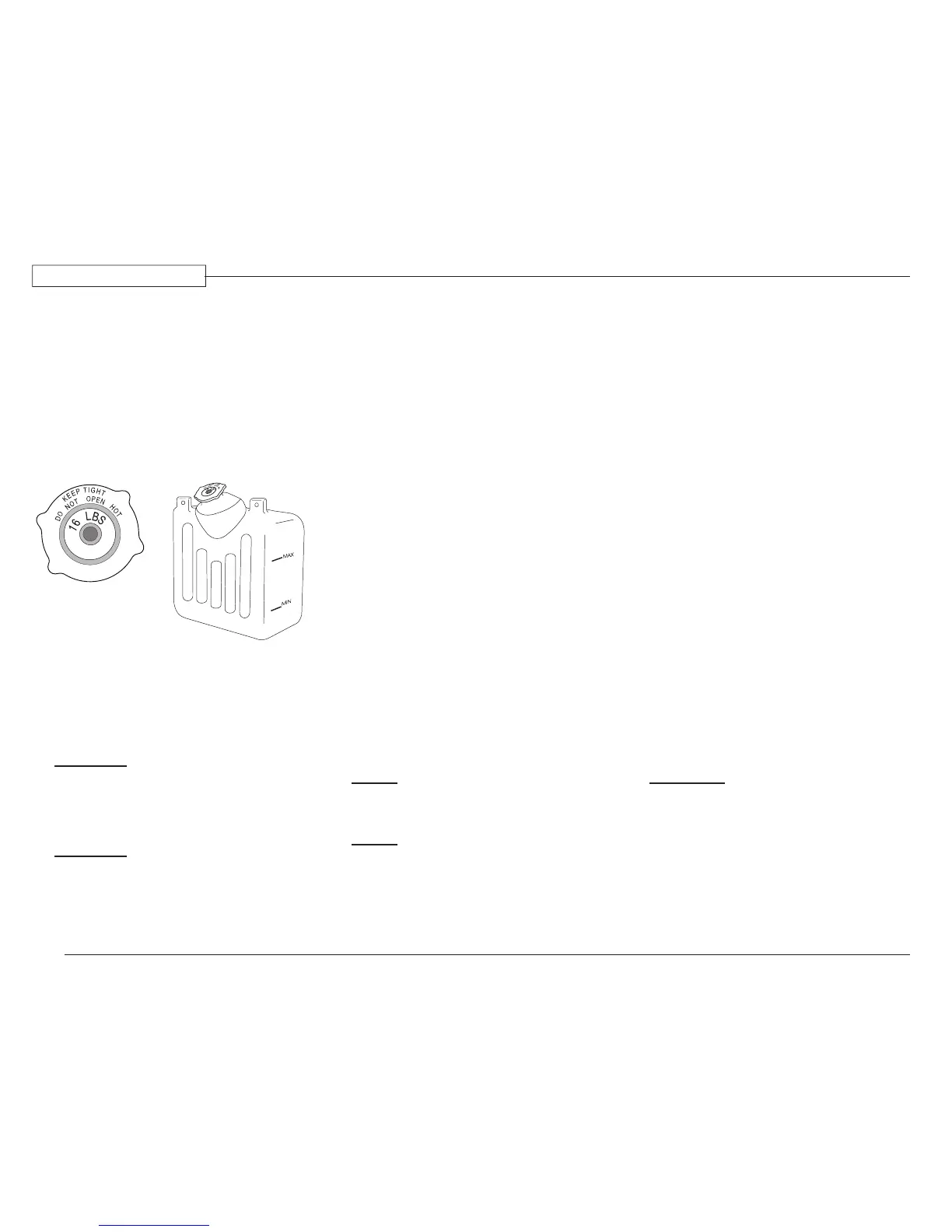
Engine Coolant Reservoir:
The engine coolant reservoir is connected
to the radiator by a hose. Coolant heats and
expands as the motorhome is driven. Coolant
displaced by expansion overows from the
radiator into the reservoir tank. Coolant
contracts as it cools and is drawn back into the
radiator by vacuum. Thus, the radiator is lled
to capacity with coolant at all times resulting in
increased cooling system efciency.
The reservoir uid level is marked MIN (cold
check)/MAX (hot check). Maintain coolant
between the appropriate reservoir indicators.
CAUTION:
DO NOT remove the reservoir cap while
the engine is running or if the engine is hot.
Cap removal can result in severe burns
and damage to the engine cooling system.
CAUTION:
Be sure to replace the cap after adding
fluid.
Coolant Checks:
Check coolant level daily or when
refueling.
A low coolant alarm will sound and a
low coolant indication will appear on the
instrument panel if coolant level drops
below acceptable levels in the reservoir.
Coolant level should remain between
the MIN and MAX indicators on the
reservoir when the cooling system is
properly lled.
Supplemental Coolant Additive (SCA):
SCA is required to protect the cylinder
liner/sleeve from cavitation erosion. Cavitation
erosion is caused by minute air pockets that
collect on the cylinder liner. The air pockets
will pop (implode) during engine operation.
Over time this can erode a hole through the
cylinder liner. Supplemental coolant additives
inhibit formation of the air pockets. The SCA
content of the coolant is checked with Litmus
paper. Test kits are available from the engine
manufacturer as well as aftermarket. Litmus
paper is time and light sensitive. Check the
SCA content at each oil change following the
directions in the test kit.
NOTE:
Refer to the engine OEM manual for
further information.
NOTE:
SCA test kits are time and light
sensitive. Store test kit in a dry and
dark location. Discard if out of date.
Pink colored antifreeze may not be
compatible with certain test kits.
Cooling System Maintenance:
Refer to the engine OEM manual for detailed
information regarding cooling system service
and maintenance intervals. Services include
draining and replacing the coolant, ushing the
cooling system, inspecting the water pump and
standpipe and replacing the thermostat, gasket
or seal.
Coolant Overheated:
The engine can overheat for a number of
reasons. Before engine temperature reaches a
critical point it is preceded by illumination of
dash indicator lamps as well as above normal
temperature gauge readings. It is best to adhere
to these indicators and take corrective action
before the engine is subjected to extreme heat
and potential engine damage.
If the engine should begin to severely
overheat, engine protection software will begin
to decrease fuel regardless of throttle position
(derate) to reduce heat created by combustion.
Damage to the engine will occur if engine
operation continues and cause of the overheat
condition is not immediately corrected. At this
point it is best to shut off the engine as soon as
possible to avoid further engine damage.
WARNING:
It is advised to shut off the engine should
the engine overheat. It may take several
hours before engine temperature has
lowered to a safe operating range. Do
not remove the coolant reservoir cap as
severe burns may result. Never add cold
water to an overheated engine as this will
cause uneven rapid cooling and possibly
result in further engine damage.
090503c
Coolant Reservoir Cap
rated at 16 lbs.
090503d
Coolant Reservoir Tank


 To Next Page