DRIVING & SAFETY — 2
30
20 08 CONTESSA
Next, start the generator. This may
require using the Battery Boost switch
for the generator to start from the
engine battery. Once the generator is
operating, the electrical combination
of the generator and the inverter will
charge the batteries.
Allow the generator to run approximately ½
hour before attempting to start the engine.
After ½ hour of generator operation,
leave the generator on and hold down
the Battery Boost switch for one minute.
Release the switch for one minute, then
press the switch again for one minute.
Alternate this cycle three to ve times.
Next, hold the switch down and turn the
ignition ON. The battery voltage gauge
on the dash should indicate at least 12 Volts.
If voltage is sufcient with the Boost
switch held down, try to start the engine.
If the engine fails to crank, or fails to
crank quickly, the chassis battery may be
depleted and the motorhome will require
jump-starting or an external charger
hooked to the chassis battery.
Jump-Starting Using an External
Source:
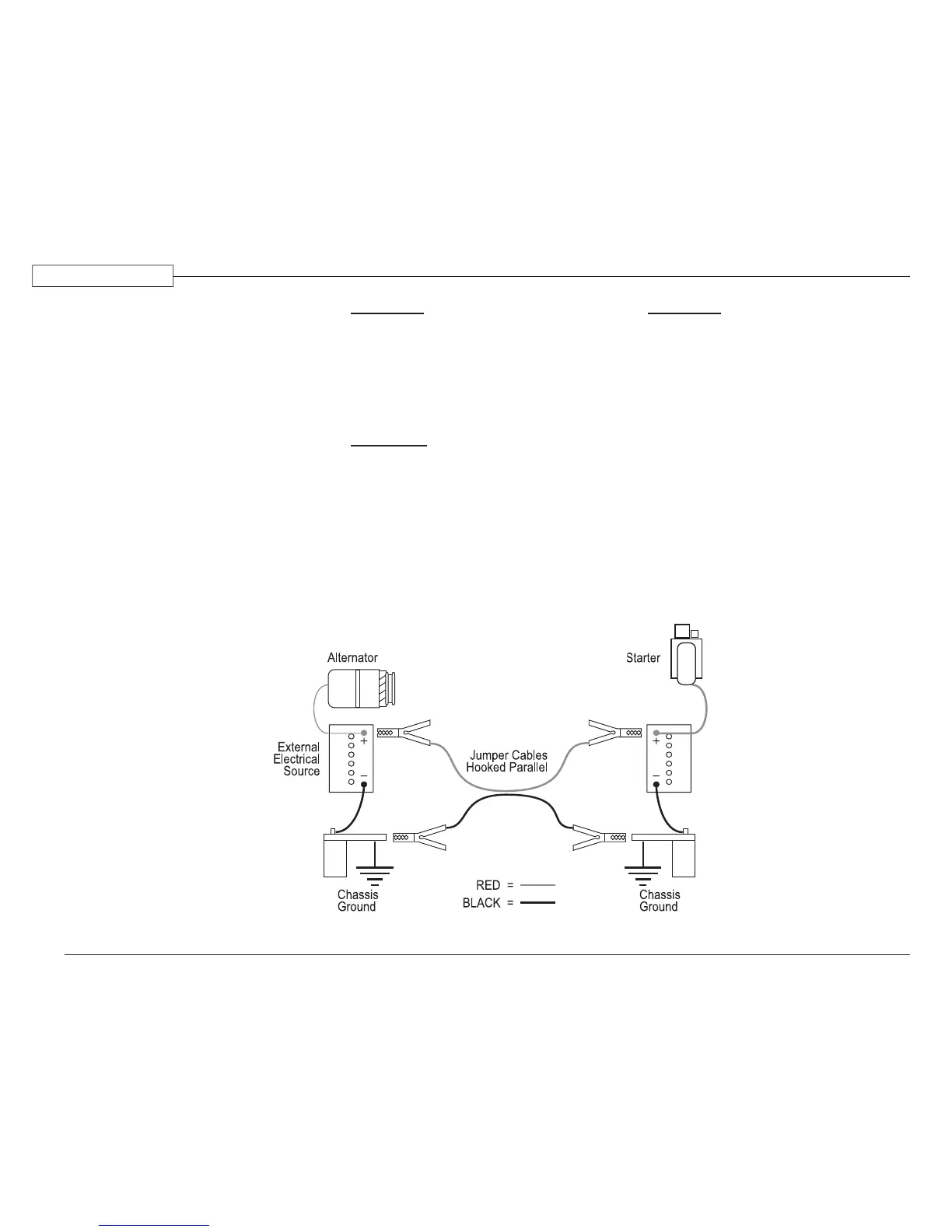
When using jumper cables to start
the engine, the cables must connect in a
parallel conguration. That is, positive
(+) to positive and negative battery (-) to
negative chassis (-). Always connect the
positive (+) before connecting the negative
(-). To prevent arcing when disconnecting
the cables; disconnect the negative (-)
before disconnecting the positive (+).
CAUTION:
DO NOT use the towed vehicle for
jump-starting. The charging system of
the towed vehicle does not supply the
amperage necessary to jump-start the
motorhome. Voltage sensitive equipment
on the towed vehicle can be damaged
and render the towed vehicle disabled.
WARNING:
Always ventilate the battery compartment
prior to any work or service to the
batteries. Gas emitted by the batteries
can explode when exposed to smoking
material, flames, sparks or other sources
of ignition, resulting in injury or vehicle
damage. Batteries contain sulfuric acid
that can burn skin, eyes and clothing.
DO NOT connect the end of the second
cable to the negative (-) terminal of the
battery to be jumped. Connect only to
the chassis, away from the battery.
CAUTION:
A large amount of electrical current is
required to jump-start an engine. The
sizes of the battery, alternator and jumper
cables supplying the “jump” are current
limiting factors. Wait a sufficient amount
of time for a surface charge to build before
attempting to start the engine. Voltage
fluctuations that occur during a jump-
start procedure can damage sensitive
electronic equipment and charging
systems. If a jump-start is necessary, it is
recommended to call Roadside Assistance.
They will have the equipment necessary
to jump-start the motorhome.
1. When using an external
electrical source to connect
to the chassis battery, turn
the main battery disconnect
switches OFF prior to
hooking up the jumper cables.
2. Hook up the cables then wait
several minutes to allow a
surface charge to build in
the chassis battery before
attempting to start the engine.
3. Turn ON the battery
disconnect switches and
attempt to start the engine.
DO NOT crank the engine
more than a few seconds.
4. After the engine has started,
disconnect the cables.
Disconnect the negative (-)
cables before disconnecting
the positive (+) cables to
prevent arcing.
080350
Typical jump-start connection.


 To Next Page