411829-L, Maintenance April 2012 Page 5-3
5
5.3 Spare Parts
A list of spare parts is available at www.biotage.com.
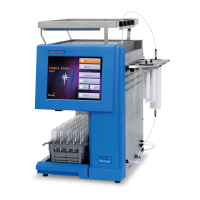
5.4 Clean the Exterior of the System
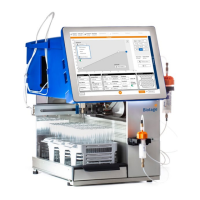
Regular cleaning of the touch screen, if performed properly, extends the touch screen life and
protects it from contaminants that cause unnecessary wear. Always turn the system off before
cleaning the screen.
WARNING
When cleaning the touch screen, use only non-ammonia based window
cleaner and do not apply the liquid directly to the screen as this could
introduce liquid into the screen electronics section, which could damage
electronic components.
NOTE
Avoid harsh cleaners and chemicals, and getting moisture inside the system.
1. Shut down the system as described on page 4-1.
2. Disconnect the power cord from the power outlet.
3. To clean the touch screen, wipe with a clean, non-abrasive, dry cloth. If this does not clean the
screen properly, then you may apply a small amount of non-ammonia based window cleaner
to a clean, non-abrasive cloth and then wipe the screen with the damp cloth. The cleaning liquid
must be applied to the cloth only. After cleaning, wipe dry with a clean, non-abrasive cloth.
4. To clean the exterior of the system, clean the surfaces using a clean, lint-free cloth, lightly
dampened with water. If required, a small amount of mild soap may also be used. After
cleaning, wipe dry with a clean, lint-free cloth.
5.5 Implement a Mobile Phase Change
To avoid faults during a mobile phase change, it is necessary to perform the change throughout the
entire chromatographic system (i.e. in the reservoir, pump, injector, column, and detector). The
procedure is to fill and flush the system, using the prime function (see page 4-33), with a series of
mutually miscible solvents until a gradual change to the new mobile phase (solvent) is
accomplished. If this procedure is not observed, precipitation may occur not only in the detector
flow cell but also in other parts of the system. For example, to change from an organic mobile
phase to aqueous solutions, it is necessary to flush the whole system with acetone or an alcohol
(e.g. isopropanol).
5.6 Clean the Detector Flow Cell
WARNING
Ultraviolet (UV) light can injure your eyes. Do not operate the Isolera
system with the detector flow cell removed and the retaining latch open.
Keep the detector flow cell clean and protect it from dust and chemical spills. Particular attention
should be paid to preventing the flow cell from leaking.
A dirty cell has decreased transmissivity, which causes increased noise level, decreased response,
and difficulties performing both auto and manual UV Zero functions.



 To Next Page